Published on November 5, 2026
Contact Dr. Raphael CV DownloadAn FCE report is evidence, not a verdict. A careful FCE evaluation for attorneys examines what the testing measured, how the evaluator interpreted performance, and whether the findings relate to the person’s actual work demands. Attorneys can challenge conclusions when the methods, safety considerations, or supporting data do not justify the stated restrictions.
That scrutiny matters. An evaluation may clarify a claimant’s functional abilities, but its conclusions can be disputed, especially when the report’s limits or reasoning are unclear. The key is to assess the evidence behind each finding rather than simply accept the report’s bottom line.
This article explains what an FCE measures, how it differs from an independent medical examination, and how attorneys can identify weaknesses in its findings. It also covers how FCE results may affect work-capacity opinions and case strategy, and what makes an evaluation more useful under legal scrutiny.
No. An insurer may weigh an FCE report alongside medical records, job demands, and other evidence, or discount findings that conflict with its assessment. For attorneys, the central question is whether the report’s conclusions align with the documented functional evidence.
A job-duty comparison tests whether measured abilities match the claimant’s actual work and documented condition. It matters because a general capacity rating may not establish whether someone can perform a specific role. Compare each restriction with the job description and medical records. For example, a lifting limit has different implications for a desk position than for work involving frequent lifting. The records can also show whether reported symptoms and observed performance align with the injury history.
Attorneys may frame the same findings differently, depending on the disputed work capacity and supporting evidence. A plaintiff’s attorney may emphasize restrictions that prevent essential duties, such as sustained standing or repeated lifting. Defense counsel may point to tasks the claimant completed, inconsistencies during testing, or medical records suggesting greater capacity. Keep the comparison specific: identify the task, recorded performance, and job demand. Mental or cognitive limitations are relevant when the claim and evaluation address them.
Courts and insurers treat FCE results as evidence of functional ability, not as an automatic decision on a claim. An FCE may inform work-capacity disputes, damages analysis, and settlement negotiations. State-specific evidentiary and procedural standards can affect whether and how findings are admitted. Courts may consider the evaluator’s qualifications, testing safety, methodology, and whether the data support the conclusions. These factors help establish the report’s evidentiary weight.
An insurer may delay, deny, or minimize a claim despite an FCE that supports restrictions. For example, it may favor its own assessment when that assessment conflicts with the FCE report. To challenge a denial based on those findings, identify the disputed conclusion and connect contrary medical records and job duties to the evaluation results. Address the stated reason for denial directly rather than relying on general disagreement.
Settlement discussions can turn on how clearly an FCE translates limitations into work consequences. A report linking reduced capacity to specific job tasks may help explain potential lost work capacity. Unexplained restrictions, by contrast, leave room for competing interpretations. Attorneys can compare the FCE with physician statements and the employer’s job description, then identify where the evidence aligns or conflicts.
For an appeal, organize the record around the insurer’s rationale: the disputed restriction, relevant medical documentation, and affected job function. If the report overlooks a documented duty or offers a conclusion unsupported by its test data, explain the gap with precise examples. The strength of the challenge depends on the evidence and applicable claim process, not simply on whether an FCE was completed.
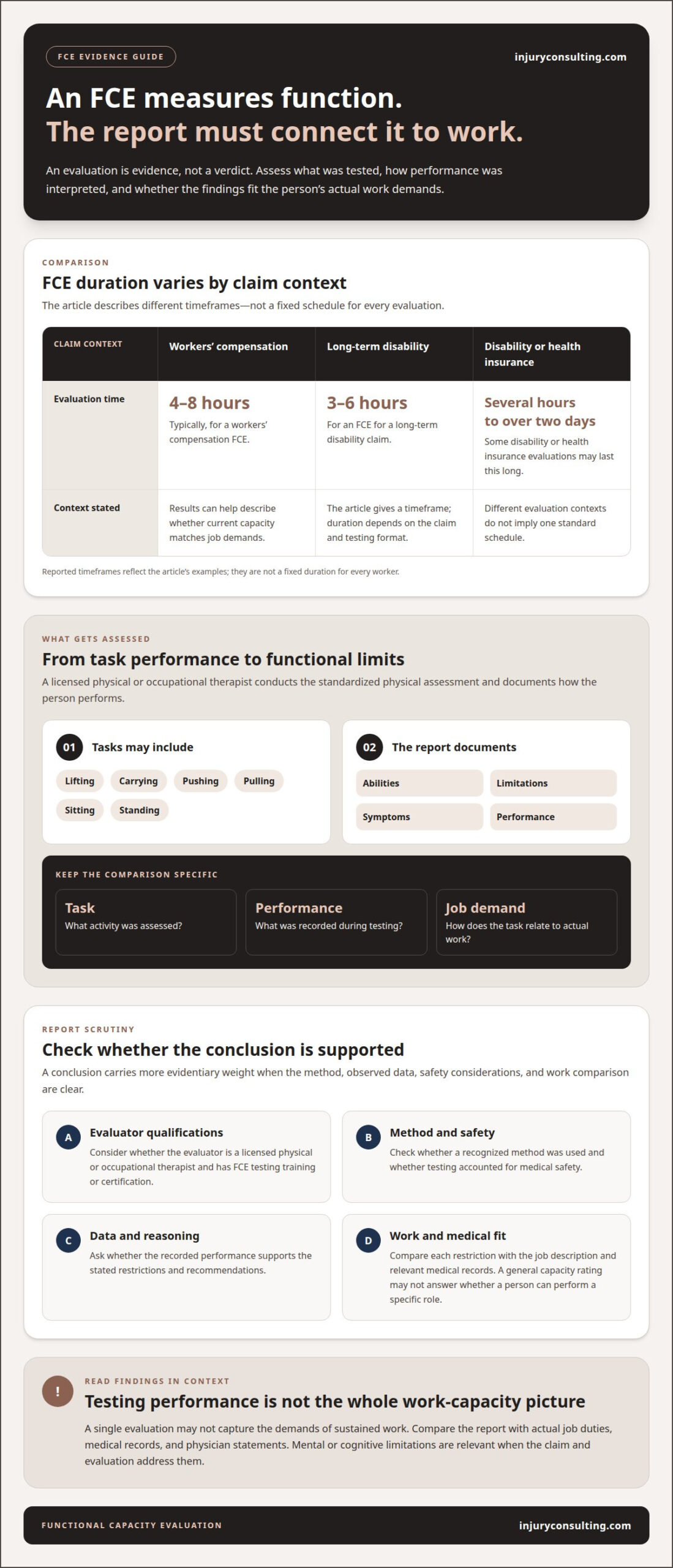
A Functional Capacity Evaluation (FCE) is a standardized physical assessment of how a person performs tasks related to work and daily activities. A licensed physical or occupational therapist conducts testing and documents abilities, limitations, symptoms, and performance. In workers’ compensation claims, the results can help describe whether an injured worker’s current capacity matches job demands. The FCE measures function; it does not, by itself, resolve every issue in a claim.
Duration depends on the claim and the testing format. A workers’ compensation FCE typically takes 4 to 8 hours, while an FCE for a long-term disability claim may take 3-6 hours. Some disability or health insurance evaluations can last several hours or even over two days. Those ranges reflect different evaluation contexts, not a fixed schedule for every worker.
The evaluator may begin by reviewing the referral question and relevant records, then move to task-based testing. Depending on the purpose, tasks may include lifting, carrying, pushing, pulling, or maintaining positions such as sitting and standing. The therapist records what the person completes and how performance relates to the stated limitations. For example, repeated lifting at work calls for a different functional comparison than primarily seated work.
When assessing an evaluator’s qualifications, attorneys can consider whether the evaluator is a licensed physical or occupational therapist, has FCE testing training or certification, and uses a recognized method. The report’s reasoning also matters: testing should account for medical safety, and its data should support its conclusions. These points help determine whether the evaluation addresses the claim’s specific functional question.
Preparation should preserve the evaluation’s independence. Explain the appointment format, the kinds of tasks the client may encounter, and the importance of following the evaluator’s directions. Do not coach the client to exceed or limit performance or to describe symptoms in a particular way. The client should report symptoms accurately during testing and raise safety concerns as they arise.
Before testing, clarify the referral question, such as whether the assessment concerns returning to a former job or capacity for other work. That focus helps the evaluator connect results to relevant duties instead of producing findings detached from the claim. The FCE report should describe observed performance and explain how the findings relate to functional restrictions. Attorneys can then assess whether the evaluation answered its intended question.
An FCE measures functional capacity through tasks related to work and daily activities. Its components show how a person’s demonstrated abilities relate to specific demands.
The physical component measures abilities such as strength, endurance, range of motion, mobility, and flexibility. These findings matter because a job may demand several movements, not just one. Testing may include lifting, carrying, pushing, and pulling, as well as sitting, standing, walking, kneeling, or climbing stairs. The selected tasks should relate to the functional question being assessed.
For example, lifting and carrying tests can help describe capacity for material-handling duties. A role involving prolonged standing raises different functional questions than desk-based work. The evaluator records performance and symptoms during tasks, creating observations that can be compared with the person’s stated limitations. Grip, dexterity, posture, and movement may also matter when they relate to the work demands under review.
Some evaluations consider cognitive functions alongside physical performance. Cognitive testing may address memory, attention, problem-solving, and decision-making. These abilities may be relevant when a role involves following instructions, managing tasks, or making judgments. The results add context to physical findings; they do not replace the assessment of physical capacity.
Work-capacity testing compares demonstrated function with relevant job activities. The evaluator documents completed tasks, symptoms, and consistency during testing. A report may describe strength, endurance, range of motion, lifting ability, and restrictions. Together, these findings help explain which activities a person can perform and where limitations affect work duties.
No single task list answers every functional question. Testing for a warehouse role may emphasize lifting and carrying, while sitting tolerance may be more relevant to an office position. The assessment is more useful when each test connects to an identified work demand. Results can then describe function in practical terms rather than relying only on a general capacity label.
Attorneys reviewing measurements can trace the report’s reasoning: which task was tested, what performance was recorded, and how the evaluator linked it to a restriction. For example, read a lifting finding in light of its stated testing conditions and the job’s lifting demands. This connection helps distinguish measured ability from assumptions about what the person can sustain at work.
FCE results describe performance during the assessment, not necessarily every aspect of a full workday. A single-session evaluation may not show how capacity changes with prolonged or repeated activity. The report’s task descriptions, symptoms, and consistency findings provide a basis for assessing what the measurements support and where their application is limited.
An FCE and an independent medical examination (IME) answer different questions, even when both concern an injured worker. An FCE uses task-based testing to describe functional performance. An IME is typically a one-time examination by a physician hired by an insurance company. The distinction matters when a claim disputes medical condition, work capacity, or both.
An FCE focuses on what a person can do during specified activities. An IME focuses on a physician’s medical examination and opinions. For example, an IME may address diagnosis or medical status, while an FCE may measure task performance relevant to work duties. Neither format automatically resolves a claim. Attorneys should connect each opinion to the question it actually evaluates.
Conflicting opinions call for a direct comparison of methods and reasoning. If an IME physician says an injured worker can return to work but an FCE records difficulty completing relevant tasks, identify the precise disagreement. Compare the IME’s medical conclusions with the FCE’s task observations, then consider whether each addresses the same job demands. Different conclusions alone do not establish which assessment is better supported.
In medical malpractice cases, an FCE may help establish baseline capabilities, describe changes in functional capacity, and provide data relevant to damages. For example, comparing documented abilities before an alleged incident or treatment with later performance can clarify the claimed functional change. The assessment can add information about daily activities and work capacity. Interpret its findings alongside the medical record and the specific opinions at issue.
Safety matters during physical testing. An evaluator should administer tasks cautiously to avoid causing further injury. If a client reports symptoms during a task, the report’s account of the event and the evaluator’s response can affect how the findings are understood. Attorneys can examine whether testing conditions were appropriate and whether recorded performance supports the evaluator’s conclusions.
FCE limitations include the gap between observed testing and sustained work performance. A brief assessment may not establish how a person functions through a full work schedule, especially when duties involve repeated exertion. Results can also be difficult to interpret if task selection does not match the disputed job demands or the report’s reasoning is unclear.
Reliability depends on the connection between the referral question, testing method, recorded observations, and conclusions. For example, a lifting result has limited value when a disputed job duty is at issue if the report does not explain how the task relates to the work. Attorneys can assess whether the evaluation documents performance consistently and distinguishes observations from broader opinions about capacity.
Read the FCE and IME together, but do not treat them as interchangeable documents. Identify what each professional assessed, the evidence each considered, and whether the conclusions address the same issue. This comparison helps attorneys determine whether an opinion supports compensation, work restrictions, or another disputed claim question.
An FCE can shape a disability claim, but its conclusions depend on the method and evidence behind them. A focused challenge identifies a specific weakness and explains how it affects the reported ability to work. General objections do little to address the evaluation’s actual reasoning.
Begin by assessing the evaluator’s qualifications and testing method. Consider whether the evaluator has relevant certification, used a recognized methodology supported by research, and conducted testing safely. Then trace the report’s reasoning: do the recorded test results support each restriction and recommendation? For example, if a report recommends reduced lifting capacity, determine whether its documented tests support that limit. A gap between measurement and conclusion gives the challenge a concrete basis.
Next, compare the tests with the claimant’s actual occupational duties. An evaluation may measure lifting or standing, while the claim concerns repeated tasks, specific postures, or other job demands. Identify which duties the FCE addressed and which its testing did not represent. This comparison shows whether the report’s conclusions apply to the work at issue rather than to general capabilities.
Examine what a single testing session can establish. A single-session FCE may not show how a worker performs over a full workday or workweek. If the report makes broad claims about sustained capacity, distinguish observed testing performance from conclusions about prolonged work. The goal is not to dismiss the assessment, but to define what its evidence supports.
Compare the report with medical records and other documented opinions. Identify specific inconsistencies, such as a restriction that conflicts with recorded findings or a conclusion that overlooks a relevant condition. An occupational therapist’s observations may add functional evidence, while medical records provide context about the claimant’s condition. Explain how each conflict affects the disputed ability instead of simply listing disagreements.
Organize the challenge around the report’s own logic: the test performed, the result recorded, the conclusion drawn, and the job function affected. For example, show whether a recommendation follows from measured performance or relies on an assumption the report does not explain. This structure gives a reviewer a clear path through the evidence and keeps the dispute focused on reliability and relevance.
For physical therapy evidence that requires independent analysis, engage a physical therapy expert witness to assess the FCE methodology and its conclusions.
Injury Consulting LLC provides Functional Capacity Evaluations for attorneys who need a documented assessment of a claimant’s functional abilities and work limitations. Turn to this service when a case requires analysis of physical capacity, or when an existing evaluation’s methods or conclusions need closer scrutiny.
Dr. Raphael Sadiwa’s work draws on peer-reviewed data and 30 years of clinical experience. Reports are designed to be defensible in court and withstand cross-examination. For related case needs, Injury Consulting LLC also provides Physical Therapy Expert Witness services, Life Care Planning, and Life Care Planning Rebuttal.
Discuss the evaluation question and relevant case context with Injury Consulting LLC to determine whether an FCE or related analysis fits your matter. Call, text, or email to discuss your case.
Use the evaluation to inform the next decision in the case, not merely to add another report to the file. Identify the precise issue that needs resolution, such as the effect of a functional restriction on a disputed work demand. Then organize the record so each opinion addresses that issue directly. This keeps the evidence focused for negotiation, claim review, or court presentation.
A sound FCE evaluation for attorneys also requires a clear distinction between what the evaluator observed and what the case must establish. Keep that distinction visible as the record develops. It helps counsel assess whether additional functional analysis would clarify a material question or whether the existing evidence already addresses it.
For a case-specific discussion of functional evidence and expert analysis, contact Injury Consulting to discuss your case. A focused review can help you determine the most useful next step for your matter.
An FCE can provide functional evidence relevant to eligibility, work restrictions, or a claim appeal. For example, if an insurer questions whether a claimant can resume work, the findings can describe which duties the claimant performed during testing. Attorneys can consider that information alongside policy terms, medical records, and job requirements when responding to a claim decision. The report informs the evidence review; it does not decide coverage by itself.
No. An FCE focuses on performance during functional tasks, while an IME is a medical examination conducted by a physician, often at an insurer’s request. They can address related but distinct issues. For instance, an IME may discuss medical status, while an FCE records task performance relevant to work. If the opinions differ, compare the questions each assessment addressed before treating them as contradictory.
After a worker’s compensation FCE, the results are compiled into a report and provided to the worker’s doctor. The report can inform discussions about work capacity, restrictions, or the next stage of a claim. For example, if the findings describe difficulty with duties the employer requires, that information may shape return-to-work planning. The report becomes one part of the claim record, considered alongside other relevant evidence.
Compare different conclusions by issue, not simply by counting them. Identify the exact point of disagreement, such as the ability to perform a particular task, and note the evidence supporting each opinion. A treating physician’s recommendation may address medical care, while an FCE records performance during testing. Clear distinctions help an attorney explain whether the opinions conflict or answer different questions.
A treating physician, specialist, or insurance company may request an FCE. In disability claims, an insurer or disability attorney may also recommend or require an evaluation as part of claim review. The requesting party and purpose can affect what the evaluator is asked to assess. For example, a referral may focus on whether the claimant can perform particular work duties or meet a functional requirement in a disability claim.
There is no single decision-maker for every claim. A doctor or claim participant may request an evaluation, while an insurer may require one under its claim process. An FCE is not required for every long-term disability claim. The decision generally turns on the functional question at issue, such as whether available records explain the claimant’s work capacity or whether additional task-based evidence is needed.
An FCE evaluation for attorneys is a structured assessment used to document functional abilities relevant to a legal claim. Depending on its scope, it can measure physical performance and may address cognitive abilities tied to work or daily activities. For example, a report could document lifting performance or attention-related testing. Its value lies in presenting observations counsel can assess against the claim’s specific functional question.
Attorneys may use an FCE when work capacity or functional loss is disputed. In a personal injury matter, results may help describe how an injury affects daily activities and work. In workers’ compensation, an evaluation may inform return-to-work or settlement discussions. In a disability claim, findings may help assess whether the claimant’s functional limits align with the policy’s disability criteria and the occupational demands under review.
Contact Dr. Raphael CV DownloadDr. Raphael reviews your case, documents every future cost your client will face. Explained in a way that juries understands. Dr. Raphael delivers a report built to survive cross-examination. Available nationwide. Call, text, or email to discuss your case.