Published on October 27, 2026
Contact Dr. Raphael CV DownloadA physical therapy expert witness can assess whether care met the applicable standard by reviewing records, diagnostic tests, treatment plans, and other relevant evidence. The expert connects clinical practice to the evidence in the case.
An expert’s opinion should explain its reasoning in terms a court can evaluate. Relevant credentials and experience also help establish whether the expert can address the specific issues in dispute. When selecting a physical therapy expert witness, match the expert’s clinical background to the question at issue.
This article explains the opinions these experts may offer and the credentials attorneys commonly assess. It also describes how consultations, depositions, and courtroom testimony can support litigation, and what to consider when evaluating expert-witness services. The focus is the process, from record review to a defensible opinion.
A physical therapy expert witness can assess whether care met the applicable standard by reviewing records, diagnostic tests, treatment plans, and other relevant evidence. The opinion should connect the documented care to accepted physical therapy practices. For example, the expert may assess whether an orthopedic rehabilitation plan addressed recorded mobility limits and strength deficits.
What cases require a physical therapy expert witness? These experts may assist with medical malpractice, personal injury, workers’ compensation, and disability cases involving physical therapy care or function. In one recent case, physical therapy was involved as a testifying expert for a civil rights violation that led to ongoing musculoskeletal injuries. The question may concern treatment decisions, rehabilitation progress, or a patient’s capacity to perform daily activities.
Standard of care and duty of care are related but distinct. Duty of care concerns the responsibility owed in a care relationship; standard of care concerns the professional conduct at issue. An expert can compare the documented assessment, goals, interventions, and progress notes with the clinical circumstances. For example, records may show the patient’s reported pain, measured movement, and response to exercises. These details help explain whether a treatment decision had a clinical basis.
Opinions must remain within the expert’s competence. A physical therapist may address physical therapy practice and rehabilitation, including care for musculoskeletal or neuromuscular conditions. A physical therapy degree, university training, and orthopedic experience can inform the analysis, but credentials alone do not establish what happened in a specific case.
Life care planning addresses a different question: what future care and support may be needed because of an injury? A plan can organize projected services, equipment, and related needs over time. Medical cost projections depend on the identified needs and the assumptions used. In litigation, a life care planning review can assess whether recommendations are supported by functional evidence and documented care. It should distinguish rehabilitation needs from broader medical diagnosis and treatment.
Acute care and intensive care rehabilitation may raise focused questions. An expert could review therapy records for documented mobility, participation, and progress during a hospital stay. For example, the analysis may compare a recorded transfer or walking activity with the patient’s documented function at that time. The opinion should explain its clinical basis, not infer events absent from the record.
What are the risks of hiring a physical therapy expert witness? A mismatch between the expert’s experience and the disputed care can weaken the opinion, while unsupported conclusions may be exposed during cross-examination. A clear review method, relevant clinical background, and careful limits help keep testimony tied to the evidence.
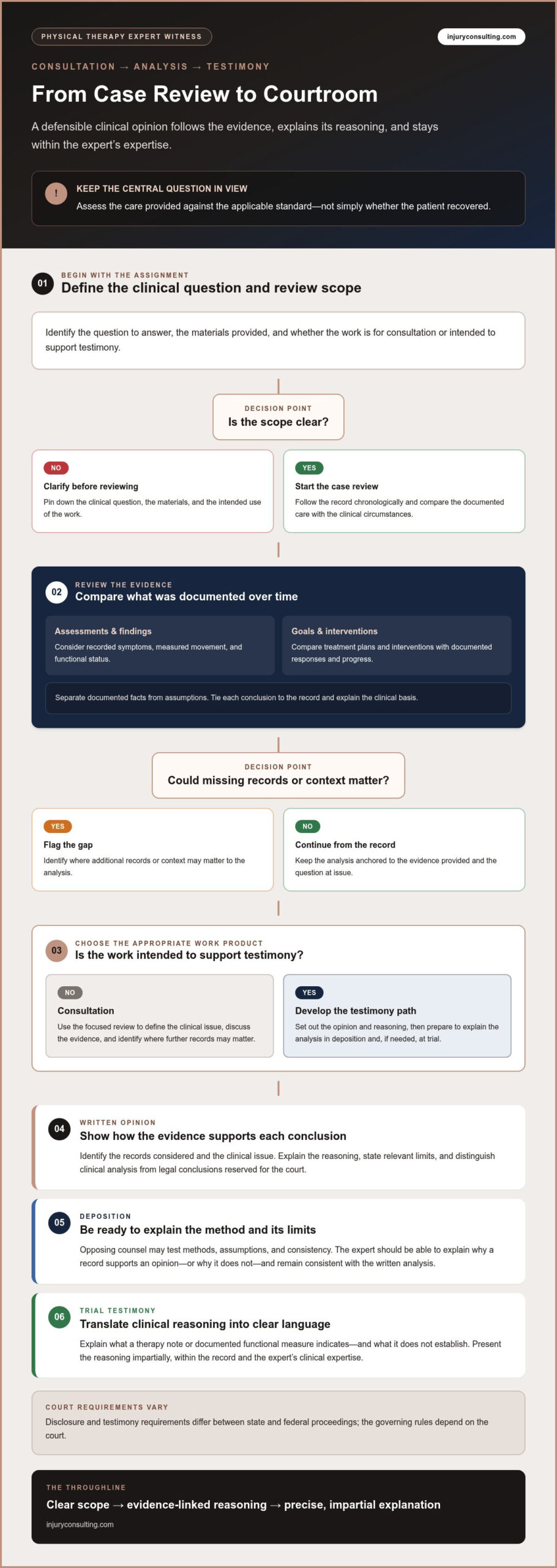
Expert work may progress from an initial consultation to record analysis, a written opinion, deposition, and testimony.
A consultation helps counsel define the clinical question before a full review begins. The expert can identify relevant medical records, missing context, and the physical therapy issues to analyze. A practical review follows the record chronologically, comparing assessments, goals, interventions, and documented responses. For example, a note recording limited walking tolerance can be considered alongside later therapy entries and functional progress.
Define the review’s scope clearly. Counsel should identify the question to be answered, the materials provided, and whether the work is for consultation or intended to support testimony. A focused case review separates documented facts from assumptions and ties each conclusion to the medical record. This makes the analysis easier to discuss during litigation and can reveal where additional records may matter.
An expert report sets out the opinion and its reasoning. A useful report identifies the records considered, the clinical issue, and how the evidence supports each conclusion. For instance, an opinion about treatment progress should explain which documented findings inform the assessment. Clear limits matter too: the expert should distinguish clinical analysis from legal conclusions reserved for the court.
At deposition, opposing counsel tests the expert’s methods, assumptions, and consistency. The expert should be ready to explain why a particular record supports an opinion, or why it does not. Counsel can prepare by reviewing the report, cited records, and factual assumptions. The goal is precise testimony that remains consistent with the written analysis, even when questions challenge its basis.
Trial testimony translates technical clinical reasoning into language jurors can follow. An expert may explain a therapy note, describe the significance of a documented functional measure, and connect that evidence to the opinion. A concrete example is more useful than jargon: explain what a recorded transfer indicates about mobility, then clarify what it does not establish.
Preparation should cover the exhibits, the likely sequence of direct examination, and areas opposing counsel may challenge. The expert must present the reasoning impartially, not act as an advocate. A reliable answer stays within the record and the expert’s clinical expertise. Counsel can also clarify which conclusions depend on specific assumptions, keeping oral testimony aligned with the report.
What rules govern expert witness disclosures and testimony in U.S. courts? Requirements vary between state and federal courts, as do admissibility standards. The applicable court rules and case orders govern what must be disclosed, when disclosure is due, and how testimony is evaluated.
Build the work plan around the procedural requirements. Counsel should identify disclosure deadlines, report requirements, and deposition scheduling from the controlling rules and orders. The expert should keep the materials reviewed, methods used, and opinions consistent across reports and testimony. Written engagement terms should also distinguish case review and report work from deposition or hearing participation, including how reimbursement and expenses are handled.
For litigation involving physical therapy records, case-specific clinical analysis can help connect documented care to the opinion presented.
How do physical therapy expert witness requirements vary by state? Licensing and admissibility standards differ across jurisdictions, and federal standards differ from state standards.
Start with the license and the clinical issues in the case. A qualified physical therapist should have specialized training and experience assessing musculoskeletal or neuromuscular conditions, as well as knowledge of physical therapy practices and standards. Then compare that background with the disputed care. An orthopedic treatment question, for example, calls for relevant orthopedic experience, not credentials that merely sound advanced.
Board certification can demonstrate focused expertise, but it does not replace case-specific analysis. Review the certification area, current licensure, clinical practice, and experience with the relevant patient population or treatment setting. A Doctor of Physical Therapy degree identifies an educational credential, but does not by itself establish experience in intensive rehabilitation, functional assessment, or the precise standard at issue.
Assess expert-witness experience separately from clinical credentials. Consider whether the expert has reviewed comparable records, formed opinions within the relevant specialty, and explained clinical reasoning under questioning. A strong patient-care background can support an opinion, while prior testimony may show familiarity with litigation demands. Neither replaces a sound method tied to the evidence.
Finally, examine independence and scope. The expert’s opinions should follow the records and clinical reasoning, not a preferred litigation outcome. Confirm that each conclusion falls within the expert’s training and practice.
Malpractice allegations require analysis of the care provided and the claimed injury. A clinical expert examines whether the physical therapy assessment, decisions, and documented interventions align with the applicable standard of care. For example, if a patient’s record reports increasing pain, the review can trace whether later notes document reassessment, modified activity, or communication with the referring doctor. The expert explains clinical issues; the court determines legal liability.
A structured record review helps distinguish an unfavorable outcome from a potentially deficient care decision. Compare the initial evaluation with treatment goals, progress notes, and discharge documentation. Check whether the therapist recorded relevant changes in symptoms, function, or tolerance. If an exercise plan continued despite documented deterioration, the timeline and clinical rationale warrant focused review. Missing entries may limit what the expert can conclude, but should not be treated as proof of a particular event.
Negligence analysis also examines whether the alleged departure is connected to the claimed harm. A patient may report a new injury during rehabilitation, but timing alone does not establish cause. The expert can compare pre-event status, the documented activity, subsequent symptoms, and later findings. The analysis should identify what the records support and distinguish it from assumptions. It should also address other documented factors that may explain changes in pain or function.
Functional capacity is another issue in disputed cases. Records may describe lifting, walking, transfers, or tolerance for daily tasks. The expert can assess whether those observations support conclusions about function and whether the documented assessment used relevant measures. An occupational therapy note may offer a separate perspective on task performance. Comparing the two disciplines’ records can clarify differences in setting, purpose, and reported ability.
Reports should show how the evidence leads to the opinion. A clear report identifies the records reviewed, the clinical question, and the reasoning behind each conclusion. It should address conflicting entries directly. For example, if one progress note records improved walking while another describes continued assistance, the analysis should explain how both observations affect the opinion. Precise limits make the report easier to evaluate at deposition.
During deposition, opposing counsel may test the expert’s assumptions, methodology, and degree of certainty. The expert should be able to identify the record supporting an opinion and explain when evidence does not answer a question. Counsel can prepare by organizing reports, key assessments, and the treatment timeline. Consistency matters: testimony should match the written analysis while responding directly to the questions asked.
A disciplined review distinguishes clinical criticism from legal conclusions. It identifies the care decision at issue, the evidence supporting the assessment, and the relationship to the claimed injury. This framework gives attorneys usable clinical analysis without overstating what physical therapy records can establish.
A physical therapy expert witness service can support litigation through clinical record analysis, written opinions, deposition, and testimony. The work should match the disputed issue. A standard-of-care question requires analysis of physical therapy practice, while a functional question may call for evidence about capacity and performance.
Begin by defining the assignment. Identify the clinical question, the records available, and the litigation stage. Then organize the evidence chronologically, noting evaluations, treatment decisions, reported symptoms, and documented responses. For example, a review of a rehabilitation case can compare an initial mobility assessment with later treatment notes and discharge findings. This gives counsel a traceable basis for discussing the opinion.
For litigation, assess the expert’s fit against the question, not just the title. A licensed physical therapist with relevant practice experience can address clinical care within their expertise. The review should also show how each conclusion follows from the record. If a report discusses a functional limitation, for instance, it should identify the observations or measures supporting that opinion.
A Functional Capacity Evaluation (FCE) may be relevant when a dispute concerns a person’s demonstrated functional abilities. Its findings can inform analysis of work-related or daily activity capacity, but should be interpreted in context. The evaluator’s methods, observed performance, and consistency with other records matter.
National litigation involves state and federal courts, and admissibility standards differ between them. A sound service therefore keeps the clinical analysis distinct from legal conclusions and makes its reasoning available for scrutiny. The clearest takeaway is practical: match the expert’s clinical background and work product to the exact issue the evidence must address. Discuss physical therapy expert witness services for a case-specific review.
Injury Consulting LLC provides Life Care Planning when litigation requires an organized analysis of future care needs and related projections. Its Life Care Planning Rebuttal can assess another plan’s assumptions and recommendations against the available evidence. For disputes focused on physical therapy practice, its Physical Therapy Expert Witness service addresses clinical opinions; a Functional Capacity Evaluation (FCE) can assess functional abilities relevant to the case.
Dr. Raphael Sadiwa’s work draws on peer-reviewed data and 30 years of clinical experience. Reports are designed to be defensible in court and withstand cross-examination. The appropriate service depends on the question before counsel: future care planning, review of an existing plan, physical therapy analysis, or functional evaluation.
To discuss the litigation issue and relevant records, contact Injury Consulting LLC.
The next decision is how to frame the clinical question your case must answer. Before retaining a physical therapy expert witness, define the disputed issue and the role the opinion needs to serve. That focus helps keep the work aligned with the evidence and litigation plan.
Injury Consulting LLC offers Physical Therapy Expert Witness services, Life Care Planning, and Life Care Planning Rebuttal. Consider which service fits the issue: clinical analysis, future care planning, or review of an existing plan. A clearly scoped assignment gives counsel and the expert a shared starting point.
Bring the central question and relevant case materials into the initial discussion. From there, the appropriate scope of work can be considered without losing sight of the legal and clinical issues. Contact Injury Consulting LLC to discuss the needs of your case and take a focused next step.
Reviewers compare reported limitations with observed tasks and the clinical record over time. A note about difficulty climbing stairs, for example, can be considered alongside documented transfers, walking ability, and assistive-device use. Assess recovery by looking for changes across evaluations, including gains, setbacks, and remaining limitations. An FCE can provide structured information about functional performance, interpreted alongside other relevant evidence.
The review considers whether the plan’s goals and exercises correspond to the patient’s documented presentation. A reviewer can compare the initial evaluation, exercise instructions, later progress notes, and recorded changes in symptoms or function. For example, if an exercise was modified, the record may show why and how the patient responded. This helps distinguish a planned adjustment from an unexplained gap in care.
The evaluation compares documented clinical decisions with relevant physical therapy practice and the circumstances at the time. The reviewer examines assessment findings, treatment choices, patient response, and communication recorded in the file. A concern about a missed reassessment, for example, should be considered against the patient’s documented condition and subsequent care. The opinion explains the clinical reasoning; legal liability remains for the court to determine.
Not for every assignment. Injury Consulting provides expert-witness testimony nationwide, while the need for in-person attendance depends on the proceeding and its arrangements. Life Care Planning is also available nationwide. Functional Capacity Evaluations are available only in Texas. Attorneys can define the required work at the outset, including whether the engagement involves record review, a deposition, or testimony before a court or hearing body.
A physical therapy expert witness provides clinical analysis for a legal matter. The work may include reviewing records, explaining physical therapy practice, preparing an opinion, and giving deposition or trial testimony. For example, an expert can clarify what a therapy evaluation documents about mobility or treatment response. The expert explains clinical issues within their expertise, not legal matters or the outcome of the case.
Look for an active physical therapy license, clinical experience relevant to the disputed care, and a clear ability to explain the basis for an opinion. A specialist credential may support expertise in a focused area, but its relevance depends on the case question. Review the expert’s experience with comparable clinical settings and records. Reports and testimony should stay within that scope and distinguish evidence from assumptions.
Start by defining the clinical issue, then compare it with the expert’s license, practice background, and relevant specialty. Review available reports or testimony history to see whether conclusions connect clearly to evidence. Consider how the expert handles conflicting records and limits an opinion. Injury Consulting provides physical therapy expert witness services for attorneys handling injury and disability matters.
Fees depend on the case and are provided after a quote request. The scope of record review, complexity of the clinical issues, report requirements, deposition preparation, testimony, and travel arrangements can affect the engagement. Ask for the proposed work to be defined clearly, including which tasks are included and how additional work is handled. This allows counsel to assess the scope before proceeding without relying on a generic hourly figure.
Contact Dr. Raphael CV DownloadDr. Raphael reviews your case, documents every future cost your client will face. Explained in a way that juries understands. Dr. Raphael delivers a report built to survive cross-examination. Available nationwide. Call, text, or email to discuss your case.