Published on October 13, 2026
Contact Dr. Raphael CV DownloadA detailed life care plan can still be difficult to defend if its recommendations don’t connect clearly to the evidence. In litigation, each projected need and future-care assumption may be tested against the records, the individual’s clinical history, and the planner’s reasoning. A defensible life care plan makes those connections visible.
Uncertainty is part of projecting future care. The key is whether the plan identifies its assumptions, explains its methodology, and shows how case-specific evidence supports each recommendation. Gaps and conflicting records don’t disappear in a polished report. They need to be addressed transparently, with a clear explanation of how they affect the analysis.
This guide explains the core components of a litigation-focused plan and how to trace recommendations to records and supporting evidence. It covers documenting projections, evaluating assumptions, and identifying vulnerabilities before relying on the plan. The goal is a clear, evidence-based analysis that can be examined on its merits.
A defensible life care plan makes its reasoning and supporting evidence reviewable. A reader should be able to trace each recommendation from its conclusion back through the rationale to relevant case-specific records. The plan should also distinguish what the records establish from what the planner projects. Detail helps organize the analysis, but length alone doesn’t show that a recommendation is supported.
Completeness and defensibility answer different questions. A complete report may list services, equipment, and projected needs. A defensible report explains why each item belongs in this individual’s plan, what evidence supports it, and where uncertainty remains. A long list without that analytical connection can invite questions about whether recommendations reflect documented circumstances or rely on broad assumptions.
For each recommendation, make the reasoning visible: identify the relevant records, explain how they relate to the proposed need, and state any assumptions used to project future care. For example, a proposed service’s frequency and duration should have a case-specific rationale, not simply appear as figures in a table. Transparent assumptions let reviewers assess the projection without mistaking it for a documented current need.
Defensibility is the ability to examine how case-specific evidence and stated assumptions support each recommendation. That standard doesn’t require pretending every future need is certain. It requires showing what is known, what is projected, and why the projection is reasonable based on the information considered. If records conflict or leave an unanswered question, the analysis should explain the limitation rather than obscure it with added detail.
A clear methodology can strengthen a report’s analytical quality, but it doesn’t decide whether the report or testimony is admissible. Nor does admissibility determine how much weight a judge or factfinder will give the opinions. Those are legal determinations shaped by applicable rules, case facts, and procedural posture. Evidentiary standards differ across jurisdictions, so no single test should be treated as universal.
For that reason, references to Daubert or another evidentiary standard require attention to the specific court and context. A plan’s documentation can help explain its foundation and reasoning, but it cannot guarantee a ruling, verdict, or acceptance by opposing counsel. The practical goal is narrower and more rigorous: make the analysis transparent enough that its support, limits, and assumptions can be evaluated on their merits.
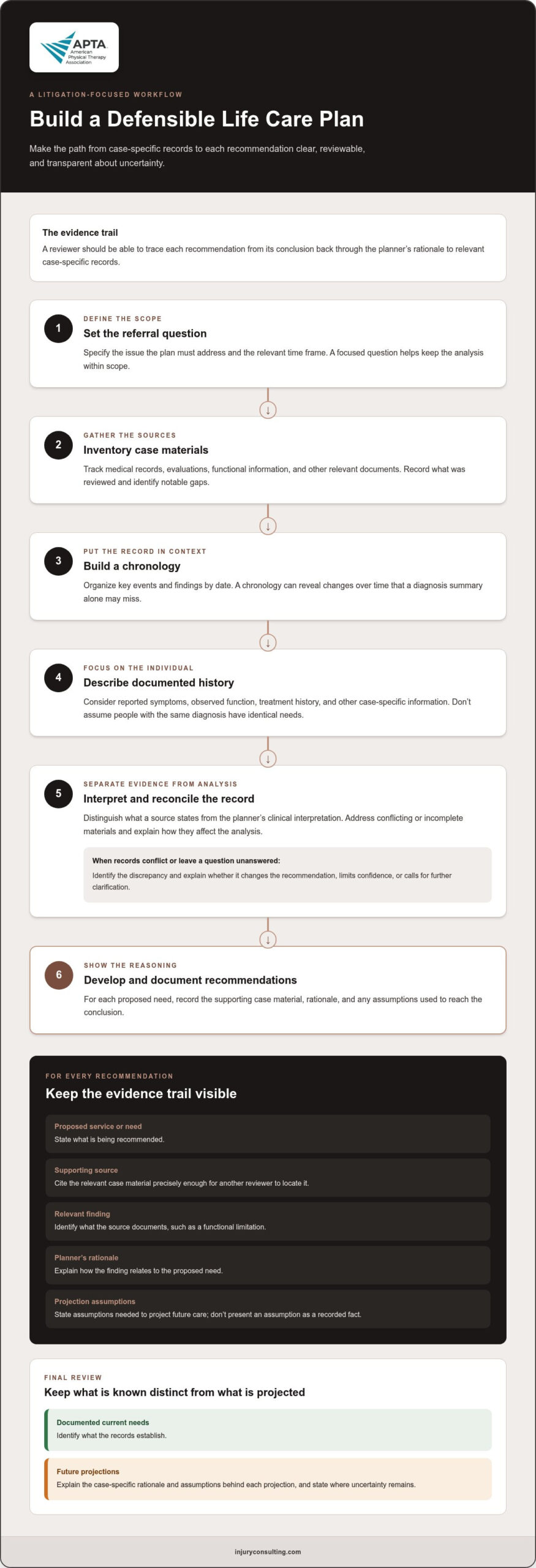
A defensible life care plan takes shape through a documented sequence of decisions. The workflow should let a reviewer see what question the planner addressed, what materials informed the analysis, and how the evidence supports each recommendation. Keep source material, clinical interpretation, assumptions, and conclusions distinct. This structure makes the reasoning easier to follow and helps expose gaps before they become hidden in the final report.
Start with an organized record set, not a diagnosis label. Inventory the available materials, note their dates and authors, and arrange them in a chronology. Flag missing periods, inconsistent accounts, and records that may need clarification. These steps help define what the file can support and where the analysis must remain qualified.
Use a consistent entry for each recommendation: the proposed service or need, its supporting source, the relevant finding, the planner’s rationale, and any projection assumptions. For instance, if a recommendation depends on a documented functional limitation, identify the record that describes it and explain how that limitation informs the proposed need. If the file doesn’t establish a detail, state the assumption required for the projection instead of presenting it as a recorded fact.
Make citations precise enough that another reviewer can locate each source without searching the entire file. An organized index or record reference also helps distinguish evidence from interpretation. If two sources differ, identify the discrepancy and explain whether it changes the recommendation, limits confidence, or calls for further clarification. Don’t silently select the account that best supports a preferred conclusion.
Traceability makes a plan easier to review because each recommendation can be tested against its source material and stated rationale. This discipline supports efficient quality review and gives counsel a clearer view of the analysis’s foundation and limits.
For attorneys developing a case-specific plan, life care planning support can organize the clinical analysis around the individual’s records and documented needs.
Future care projections require more than a diagnosis and a list of possible services. The planner must explain how this person’s documented function, treatment history, and other relevant records support each proposed service, its frequency, and its duration. A recommendation that fits one person with a particular diagnosis may not fit another. The individual record controls the analysis.
Consider the relationship between the person’s functional limitations, the care already received, and the need being projected. Records may directly support a current need or offer only partial support for a future service. Peer-reviewed data can inform clinical reasoning, but it doesn’t replace case-specific evidence. Where records conflict, support is incomplete, or a recommendation depends on an assumption, identify that limitation clearly.
A simple evidence map can help reviewers distinguish the recommendation from its basis and uncertainty. The example below is illustrative, not a conclusion about any particular case.
| Recommendation | Supporting evidence | Rationale | Uncertainty |
|---|---|---|---|
| Projected assistance with a daily activity | Records describing the individual’s functional limitations and assistance needs | Explain how the documented limitation relates to the proposed task and level of support | Clarify whether the records establish a continuing need or whether duration is projected |
Use this structure for each material recommendation, including proposed frequency and duration. If the record supports the need but not how often it will be required, state how frequency was estimated and which assumptions the estimate depends on. Don’t turn a plausible possibility into a settled conclusion.
Separate current documented needs from future projections. For every projection, state the evidence and reasoning behind its timing, frequency, duration, and any anticipated change in care. A recommendation may be well supported in one respect and uncertain in another. For example, records may support assistance with a task now, while the expected duration remains less certain. Make that distinction explicit and note reasonable alternative interpretations when they affect the conclusion.
Cost analysis needs the same traceability. Identify the source used for each projected service and document relevant details such as the service type, setting, geographic basis, and date of the source. Explain how the source corresponds to the recommended care. Avoid relying on an unexplained figure or presenting a general estimate as a universal rate. If the cost basis is incomplete or doesn’t closely match the proposed service, disclose that limitation.
A defensible life care plan presents projections as reasoned estimates, not guaranteed outcomes. Clear links among records, clinical interpretation, assumptions, and cost sources let reviewers evaluate both the recommendation and its limits.
Before relying on a plan, review it as a careful reader who hasn’t followed the analysis from the start. Test whether each major conclusion follows from the cited records and stated rationale. The goal isn’t to defend every recommendation at all costs. It is to find weaknesses, address them accurately, and make the limits of the analysis clear.
Use a consistent quality-control checklist. Review the report from the recommendations back to the underlying case materials, not only from beginning to end.
Look for conclusions that sound more certain than their support allows. For example, a record may describe a limitation at one point in time without establishing how long it will continue. Ask whether the plan explains the basis for projecting duration, addresses relevant contrary information, and identifies remaining uncertainty. If the rationale depends on a particular interpretation, make that dependence visible.
Evidence gaps don’t always prevent analysis, but they can narrow what the analysis supports. State which records are unavailable or inconsistent, which conclusions they affect, and whether an alternative interpretation remains plausible. A limitation stated plainly is more useful than an assumption presented as fact. Keep the language proportional to the evidence: distinguish a supported conclusion from one that is conditional or less certain.
If new records materially change the factual basis, assess which recommendations are affected. Document what changed, how the new information alters the reasoning, and whether conclusions need revision. Preserve a clear distinction between the earlier analysis and any updated assessment so a reviewer can understand why the plan changed.
This quality-control process is an analytical review, not a litigation strategy. It identifies vulnerabilities in the plan’s support and reasoning. A separate life care planning rebuttal evaluates another expert’s opinions; cross-examination planning involves different legal and strategic considerations. A defensible life care plan should withstand careful review without claiming that any review can guarantee acceptance or a particular outcome.
If a plan’s assumptions or recommendations need independent analysis, request a life care planning rebuttal for a focused review of another plan’s reasoning and support.
Future care questions often require focused analysis of the individual’s records, documented function, and anticipated needs. A case-specific expert engagement can help clarify which recommendations have support, where projections depend on assumptions, and what limitations should remain visible. The purpose is to provide clinical analysis for litigation, not to decide legal issues or predict a case outcome.
Injury Consulting LLC provides Life Care Planning to assess future care needs and Life Care Planning Rebuttal to analyze another plan’s recommendations and support. These are distinct engagements. Physical Therapy Expert Witness work or a Functional Capacity Evaluation may be relevant when the case question concerns physical therapy opinions or functional capacity. The appropriate scope begins with the issue counsel needs examined.
Dr. Raphael Sadiwa brings 30 years of clinical experience to this work. His analysis draws on peer-reviewed data alongside the individual’s case-specific records. Reports are designed to present the reasoning and support clearly for litigation scrutiny and cross-examination. No report can guarantee admissibility, acceptance by opposing counsel, or a particular ruling or outcome. Injury Consulting LLC provides expert analysis, not legal representation, medical diagnosis, or treatment.
Before discussing an engagement, attorneys can identify the referral question and the litigation stage. Organize available records and note the specific issues that need expert analysis. A focused starting point helps define the scope and separate the central question from related issues that may require separate consideration.
This preparation doesn’t need to resolve every uncertainty in advance. It gives the expert a clear starting question and helps surface missing or conflicting information that may affect the analysis. A well-defined scope keeps the work tied to the case rather than allowing the report to become a general discussion of possible care.
For attorneys handling injury and disability cases nationwide, Injury Consulting LLC develops case-specific life care plans and related expert analysis. If you need a defensible life care plan grounded in the individual’s records and prepared for scrutiny, discuss your case-specific life care planning needs.
Define what the case needs the life care planning analysis to clarify. Identify the referral question, the records available, and any disputed future-care issues. A focused scope gives the expert a practical starting point and keeps the analysis tied to the evidence and the needs of the case.
A defensible life care plan isn’t a promise about what a court will decide. It is a structured clinical analysis that makes its reasoning available for evaluation. Clear questions and organized materials help the work address the issues that matter without overstating what the record supports.
Injury Consulting LLC works with attorneys nationwide on case-specific life care planning and related expert analysis. Discuss a life care planning engagement with Injury Consulting LLC to identify a suitable next step for your case.
No. A defensible life care plan presents reasoning, sources, and limitations that can be examined. Admissibility is a court’s decision. Applicable rules, the evidentiary record, and the case context all matter, so report quality alone doesn’t resolve the issue. A recommendation may be clearly supported yet still face a legal challenge. Defensibility helps others evaluate the analysis; it doesn’t guarantee admission or determine how much weight the court assigns.
Yes. Uncertainty doesn’t automatically invalidate a plan, but it should be visible. The analysis can distinguish needs supported by current records from projections that depend on assumptions about future function or care. For example, records may support a service now without establishing how long it will be needed. State that limit and explain its effect on the projection rather than presenting an uncertain duration as a precise prediction.
The analysis should identify the conflict and assess whether it changes the recommendation. A record isn’t automatically controlling just because it differs from another source; its relevance depends on what it documents and how it relates to the issue. If one note describes improved function while another records ongoing limitations, explain how both inform the conclusion. A material conflict may call for further review or a conclusion limited to what the available evidence supports.
Not in every case. Whether an update is useful depends on developments that could affect the analysis, such as newly available records, a later evaluation, or a material change in documented function. An update should address what has changed and whether it affects recommendations or projections. Reformatting an existing report without reviewing relevant developments is different from substantively reassessing its analysis. Any timing or procedural requirement depends on the case and applicable rules.
It may, if the proposed future care has case-specific support and the analysis explains its clinical rationale and assumptions. A projected recommendation is not the same as an existing prescription or treatment order. For instance, the records may describe a functional limitation relevant to a future service without showing that the service has already been ordered. The planner should make that distinction clear and avoid treating a projection as established current care.
Choose a major recommendation and trace it to the cited records, rationale, and projection assumptions. Look for frequency or duration that appears without explanation, or a conflict the report doesn’t address. Then check whether the conclusion goes beyond what its cited support establishes. This is a screening step, not a full expert review. For a more systematic assessment, use the pressure-test checklist in this article.
Contact Dr. Raphael CV DownloadDr. Raphael reviews your case, documents every future cost your client will face. Explained in a way that juries understands. Dr. Raphael delivers a report built to survive cross-examination. Available nationwide. Call, text, or email to discuss your case.