Published on October 18, 2026
Contact Dr. Raphael CV DownloadHow much time should you reserve for an FCE? The question “how long does a functional capacity evaluation take” has no single answer. A typical evaluation may take 2 to 8 hours and can be completed over one or two days, but that range isn’t a universal rule. The appointment’s scope and the questions it needs to address matter.
It’s reasonable to plan carefully, especially if you’re concerned about fatigue or a flare in symptoms. FCEs can involve physical tasks, and evaluators monitor performance, pain, and fatigue. Different estimates may reflect differences in scope, testing methods, and case needs rather than a contradiction.
This article explains the practical time range, what can make an evaluation shorter or longer, and how to prepare. It also clarifies how to interpret the findings in context. An FCE provides evidence about functional abilities; it isn’t treatment or a guaranteed return-to-work determination. In a legal or disability matter, the evaluation’s purpose and scope help determine what its findings can support.
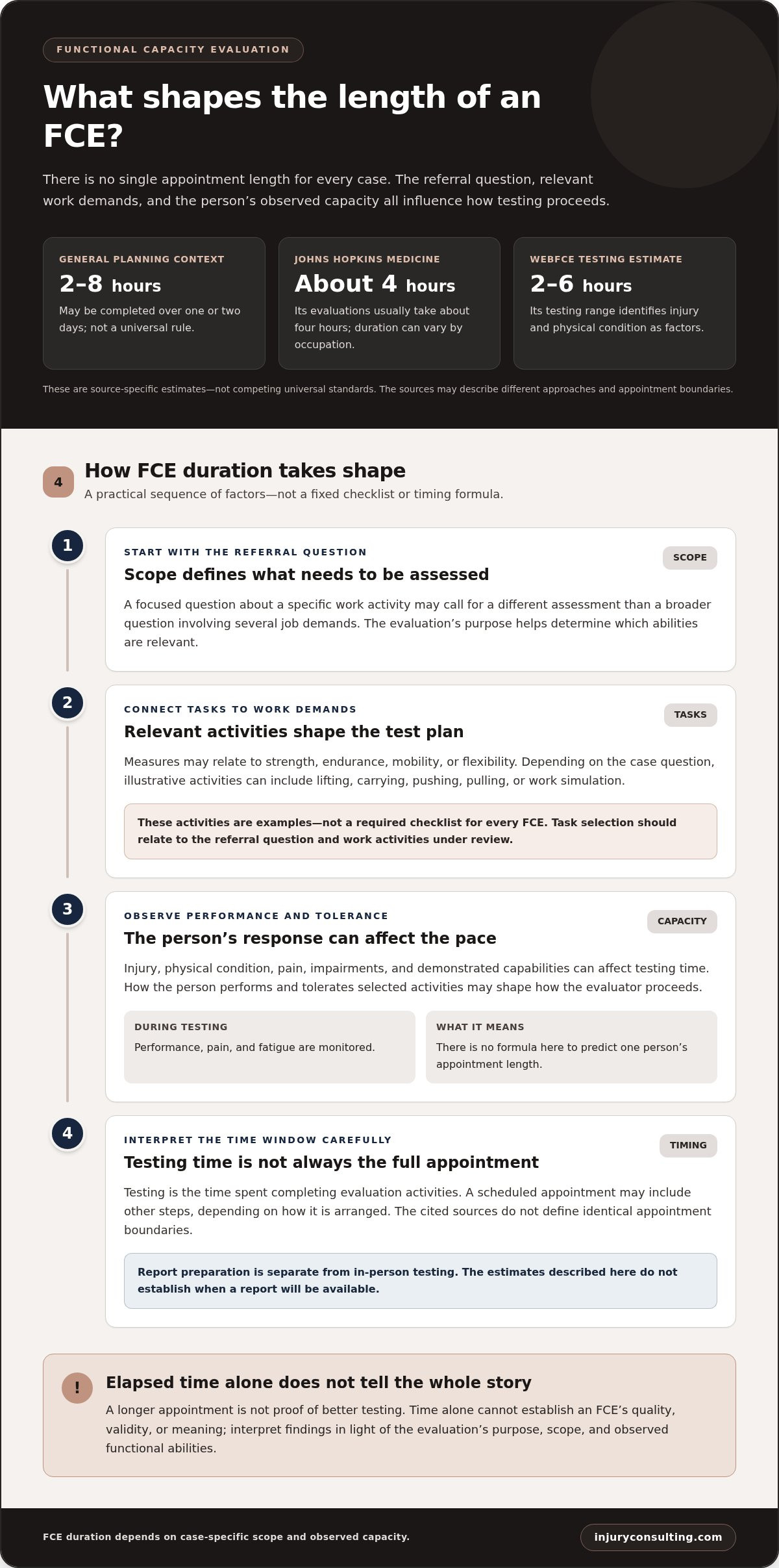
There’s no single appointment length for every case. Johns Hopkins Medicine says its evaluations usually take about four hours, while webFCE describes testing that can take two to six hours, depending on the person’s injury and physical condition. These are source-specific estimates, not competing universal standards. If you’re asking how long does a functional capacity evaluation take, use published figures as planning references, then consider the evaluation’s purpose and scope.
The tasks selected matter. An evaluation focused on a limited set of functional questions may differ from one examining abilities tied to varied job demands. The individual’s observed capacity also affects how testing proceeds. A general overview of the Functional Capacity Evaluation describes its purposes and types, but it doesn’t establish one required duration for all evaluations.
For a visual overview of FCE conduct, watch this video:
Johns Hopkins Medicine’s estimate describes the usual length of its evaluation, with duration varying by occupation. webFCE gives a two-to-six-hour range for testing and identifies injury and physical condition as factors. Each source describes its own approach, and neither establishes a universal timing rule. Team Rehabilitation’s extracted service information offers another contrast: it describes FCE services and job-related measures but doesn’t state a duration.
FCE duration varies with evaluation scope and individual factors. Johns Hopkins Medicine reports that its evaluations usually take about four hours; webFCE describes testing lasting two to six hours. Read these estimates with their source and context attached. A clinic’s usual appointment estimate and a testing range published by another provider may not measure the same thing.
Testing time is the period spent completing evaluation activities. A scheduled appointment window may include other steps, depending on how the evaluation is arranged. The sources cited above don’t define identical appointment boundaries, so their figures shouldn’t be treated as like-for-like measures.
When planning around an estimate, note whether the stated window refers to physical testing or the full appointment. Don’t assume that a testing range includes every part of the visit or that a longer window means more tasks. The evaluation’s scope determines what is relevant. Report preparation is separate from in-person testing, and these estimates don’t establish when a report will be available.
FCE duration is shaped by three related factors: the evaluation’s scope, the physical demands relevant to the work question, and the examinee’s observed capacity. These factors explain why people with similar referral concerns may complete different task sets or proceed at different paces. The question “how long does a functional capacity evaluation take” can’t be answered from a diagnosis or job title alone.
The referral question helps define what the evaluation needs to measure. If the issue concerns a specific work activity, the assessment may focus on relevant abilities. A broader question about several job demands may call for a wider range of tasks. Johns Hopkins Medicine describes evaluations in relation to job duties, while Team Rehabilitation describes measures such as strength, endurance, mobility, and flexibility in relation to job demands.
Illustrative activities may include lifting, carrying, pushing, pulling, or work simulation. These aren’t a required checklist for every FCE. The evaluator selects tasks relevant to the case question and the activities under review.
Consider two different work questions. One may focus on whether a person can repeatedly lift an item. Another may involve several physical demands associated with a particular role. Those questions can lead to different testing plans and time requirements. Task selection should be relevant, not simply extensive. More tasks don’t automatically make an evaluation more accurate or legally stronger; the connection between the tasks, referral question, and findings matters.
webFCE identifies injury, physical condition, pain, impairments, and demonstrated capabilities as factors that can affect testing time. These factors don’t provide a formula for predicting an individual’s appointment length. A diagnosis, age, or single symptom can’t establish in advance how long testing will take.
Observed tolerance can affect how an evaluator proceeds through selected activities. A person’s ability to complete a task and their response during it may shape the pace or next steps. The question isn’t just how many tasks are scheduled, but how the person performs the tasks that address the evaluation’s purpose.
In practical terms, duration may be influenced by:
These factors work together. A focused assessment may still require careful observation, while a broader job-related evaluation may involve several types of physical activity. Neither task count nor elapsed time alone establishes the quality or significance of the findings. Injury Consulting LLC provides Functional Capacity Evaluations in relation to the functional issues a case needs to address.
No. Elapsed time alone can’t establish an FCE’s quality, validity, or the meaning of its findings. A longer appointment may reflect a broader set of job-related questions, but time by itself doesn’t show whether the selected tasks were appropriate or how the examinee performed. A shorter evaluation isn’t automatically less thorough, either. The key is whether the scope fits the referral question and relevant functional demands.
The examples below are illustrative, not standardized FCE categories. They show how different evaluation purposes can affect task selection and pace, without assigning a universal session length to either approach.
| Evaluation focus | Possible task scope | Timing variability |
|---|---|---|
| Focused question | Activities tied to a specific functional issue | Depends on the task and observed performance |
| Broader job demands | Several activities relevant to work, such as lifting, carrying, pushing, or pulling | Depends on the range of demands and how testing proceeds |
A focused task set may examine a particular ability. A broader job-demand evaluation may include several activities because the work question covers more than one physical demand. Job-specific tasks can change both the content of an evaluation and its pace. That doesn’t mean every duty must be simulated or that adding tasks automatically produces a more accurate or legally stronger result. Relevance matters more than task count.
Duration is one fact about an appointment, not a standalone measure of test quality. It can’t establish how much effort a person gave, whether a method was appropriate, or what the findings mean. Those questions require attention to the evaluation’s methods, the person’s observed performance, and the evaluator’s documented findings.
An FCE shouldn’t be treated as a contest to produce maximum exertion. It addresses functional capacity in relation to its purpose. That doesn’t mean tasks are effortless or discomfort is irrelevant. Individual effort, symptoms, and tolerance may affect performance and how the evaluator proceeds. Don’t treat the appointment as a tryout or assume you must push through symptoms to prove a point.
So, how long does a functional capacity evaluation take? The answer depends partly on what the evaluation needs to examine, but length alone can’t tell you whether it was thorough. Separate clock time from scope and actual observations. The referral question provides the frame: relevant functional demands guide task selection, while the person’s performance supplies information about those tasks. Neither a long session nor a short one settles the evaluation’s quality or conclusions.
Good preparation starts with the appointment details, not an assumption that every FCE follows the same schedule. If you’re planning around work, transportation, or other commitments, use the time window provided for your evaluation rather than relying on a general estimate. The answer to “how long does a functional capacity evaluation take” depends on the evaluation plan and individual circumstances.
Use this sequence to get ready:
Review the instructions in advance so you know what to expect and what to bring. Think about the functional activities related to the referral question and how your symptoms affect them. Share current symptoms and relevant changes accurately. If pain, fatigue, or mobility has changed since the referral, describe what changed and when rather than trying to interpret its cause.
Clear, factual information is more useful than rehearsed answers. You don’t need to predict how you’ll perform or prove a particular point. The evaluation is meant to document observed function in the context of its purpose.
Report pain, fatigue, or other relevant symptoms as they arise. Don’t conceal discomfort to appear capable or push beyond your usual effort to demonstrate a specific level of ability. Accurate communication gives the evaluator context for observed performance and helps distinguish what you can do from what you can sustain under the assessment conditions.
Pacing and breaks depend on the evaluation and the individual. Don’t assume a particular schedule, guaranteed break pattern, or stopping rule unless it has been explained for your appointment. If you’re unsure how to respond to a task or symptom, communicate that directly rather than guessing what the evaluator expects.
Plan with flexibility. The scheduled window is a practical guide, not a promise about exactly when the appointment will end. Injury Consulting provides FCEs informed by the referral context and relevant functional questions. Learn about Injury Consulting’s FCE services.
An FCE can provide evidence about a person’s observed functional capacity in relation to specific activities. In an injury case, that information may help address questions about physical performance and work demands. It isn’t a medical diagnosis, treatment, or a guaranteed return-to-work decision. Nor does the evaluation itself decide a legal claim.
That distinction matters when reviewing results. Just as the answer to “how long does a functional capacity evaluation take” depends on the evaluation’s scope, the significance of its findings depends on the case question and the evidence as a whole. Appointment length can’t determine the legal weight of an FCE.
Documented performance on selected tasks can inform questions about a person’s ability to perform relevant activities. The findings may describe what was observed during the evaluation. They shouldn’t be treated as a definitive answer to every question about future work, restrictions, accommodations, or disability.
Those outcomes depend on the applicable decision process and the full record, which may include information beyond the FCE. An evaluator’s observations are evidence for consideration, not a legal conclusion. The evaluation addresses functional performance within its scope; the appropriate decision-maker determines how the evidence applies to the matter.
Injury Consulting LLC provides Functional Capacity Evaluations and physical therapy expert witness services. Dr. Raphael Sadiwa brings 30 years of clinical experience, and his work draws on peer-reviewed data. Reports are designed to be defensible in court and withstand cross-examination. The evaluation’s purpose and scope remain central to interpreting what the findings can support.
For attorneys and case teams, forensic expertise may be relevant when an FCE needs to address defined functional questions in an injury matter. A case-specific discussion can focus on the referral issues, activities at issue, and the role an evaluation or expert engagement may serve. It should begin with the question the evidence needs to address, not an assumed outcome.
Attorneys and case teams can review FCE and expert witness services in the context of a case.
Instead of treating appointment length as the main measure of an FCE, start with the decision the evaluation needs to inform. A clearly framed functional question gives the evaluation a practical reference point and keeps the discussion focused on relevant evidence. It also gives attorneys and case teams a more useful basis for planning than a time estimate taken out of context.
If you’re still asking how long does a functional capacity evaluation take, use that question to clarify the evaluation’s scope, not as a substitute for it. The right duration is the one associated with the work required to address the referral questions, not an assumed universal schedule.
For injury and disability matters, Injury Consulting provides FCE and physical therapy expert witness services. Dr. Raphael Sadiwa’s work draws on peer-reviewed data and three decades of clinical experience, with reports designed to withstand cross-examination. This experience can help case teams examine how an FCE may address the functional issues in a matter.
Attorneys and case teams can discuss an FCE or expert witness engagement with Injury Consulting. Frame the conversation around the questions at issue and the evidence the case needs to address.
Plan around the time window provided for your specific appointment. Published estimates vary: Johns Hopkins Medicine says its evaluations usually take about four hours, while webFCE describes testing that lasts two to six hours. These figures describe different providers’ approaches, not a guaranteed schedule for your visit. Note whether the appointment window covers testing or the full visit before arranging transportation or other commitments.
Yes, an FCE may occupy much of a day, and some evaluations can be conducted over one or two days. Duration depends on the evaluation plan and individual circumstances, so “all day” isn’t a default expectation. Treat the appointment window you’re given as the practical guide. If the evaluation is split across days, account for the dates and arrangements when planning work, travel, and other obligations.
Tell the evaluator when fatigue affects your ability to continue or perform a task. Fatigue is relevant information, not something you need to hide. For example, if you can complete an activity once but struggle to repeat it, describe what you’re experiencing rather than pushing through to meet an assumed standard. The evaluator can consider your reported symptoms alongside observed performance. Don’t change your usual effort to try to influence the outcome.
Breaks may be possible, but their timing and availability depend on the evaluation and your circumstances. Don’t assume a fixed break schedule. If you need to pause, or aren’t sure whether a symptom warrants a pause, tell the evaluator. Communicating promptly provides relevant context about your tolerance. Any instructions specific to your appointment take precedence over general expectations about how an FCE is conducted.
No. A longer session doesn’t, by itself, demonstrate greater accuracy. Additional time might reflect the range of activities being examined, but it doesn’t prove that each activity was relevant or that the results are more conclusive. Accuracy can’t be judged from the clock alone. Consider whether the evaluation addressed its stated purpose and whether the findings are supported by the documented methods and observations.
The testing-duration estimates don’t establish a universal report turnaround time. The time spent performing an FCE and the time needed to prepare its written report are separate. If you’re coordinating a claim or case deadline, plan report delivery separately as part of the engagement. Don’t assume the report will be ready on the day of testing.
Wear comfortable clothing and supportive shoes that allow you to move through the activities planned for the evaluation. Clothing that restricts reaching, bending, or walking may interfere with performing those movements comfortably. Follow any appointment-specific clothing instructions you receive. Bring an assistive device when requested or when it’s part of your usual mobility, and tell the evaluator how you typically use it during daily activities.
Contact Dr. Raphael CV DownloadDr. Raphael reviews your case, documents every future cost your client will face. Explained in a way that juries understands. Dr. Raphael delivers a report built to survive cross-examination. Available nationwide. Call, text, or email to discuss your case.