Published on October 20, 2026
Contact Dr. Raphael CV DownloadA life care plan’s price reflects the work needed to support its recommendations, not the projected lifetime cost of care. If you’re asking how much a life care plan costs in 2026, the fee depends on the injury’s complexity, the person’s future-care needs, the records involved, and the number of treating providers. A case-specific price is provided after a quote request.
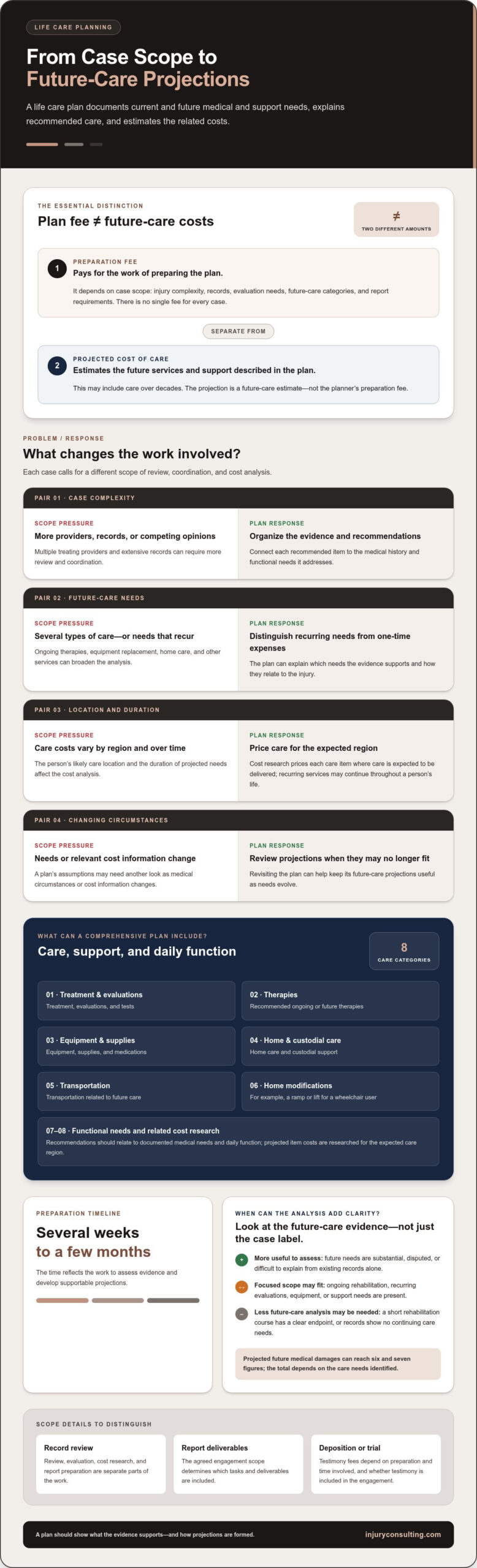
That distinction matters: the fee to prepare a life care plan is separate from the projected cost of the care it describes. A plan can assess future medical and support needs, explain the basis for recommended services and equipment, and estimate their costs.
This article explains what a life care plan may include, how case scope and documentation affect preparation, and when a plan can clarify future-care needs. It also covers why changing medical circumstances or updated cost information may call for a review.
A life care plan documents a person’s current and future medical and support needs, then connects those needs to projected costs. In a catastrophic injury case, it can organize recommended care, equipment, therapies, supplies, and attendant care in a structured report. The projected lifetime cost of care is not the fee to prepare the plan.
For readers asking how much a life care plan costs in 2026, the answer depends on the work required for the case. Preparation charges depend on case scope and are provided after a quote request; key factors include injury complexity, medical-record volume, evaluation needs, and report requirements.
For context on how future care costs can accumulate, watch this overview of long-term care pricing:
There is no single preparation fee for every personal injury or medical malpractice case. The type and number of future-care needs, the available medical records, and the analysis required shape the work. Preparing a plan typically takes several weeks to a few months, reflecting the time needed to assess the evidence and develop supportable projections. This is especially true in catastrophic injuries where information from treating providers may take weeks before a life care planner receives it.
Projected costs cover care itself, not plan preparation. A plan may estimate medical and custodial needs over decades. That projected amount represents future care, not the planner’s fee.
Geography also matters. Cost research prices each care item for the region where care is expected to be delivered, so projections should reflect the person’s likely care location. The duration of projected needs affects the total, too: recurring therapies, equipment, home care, and other services may continue throughout a person’s life.
Do life care plan fees include medical record review, examinations, and report preparation? The engagement scope determines which tasks are included. Record review, evaluation, cost research, and report preparation are separate parts of the work, so the agreed scope should identify the deliverables.
How much do life care planners charge for deposition and trial testimony? Testimony fees depend on the preparation and time involved, and on whether the engagement includes deposition or trial testimony. These are separate scope considerations, addressed in the quote for the requested work.
A life care plan can help quantify injury-related medical damages in a personal injury or medical malpractice case. Its value depends on whether future care needs are substantial, disputed, or difficult to explain using existing records alone. A mid-size case may involve ongoing rehabilitation, recurring evaluations, equipment, or support needs without a catastrophic injury. The plan organizes these needs and explains how they relate to the injury.
Injury litigation often involves more than current medical bills. Settlement discussions may also consider projected treatment, therapies, and other care over time. A plan connects each recommended item to the person’s medical history and functional needs, giving attorneys, insurers, and other case participants a clearer basis for assessing future medical damages. Such damages can reach six and seven figures, though the projected total depends on the care needs identified.
For a mid-size claim, the key question is whether the analysis adds useful evidence. A short course of rehabilitation with a clear endpoint may need less future-care analysis than an injury involving recurring treatment, equipment replacement, or ongoing assistance. A plan should not inflate a claim. Its purpose is to show which future needs the evidence supports, how they relate to the injury, and what assumptions inform their projected cost.
Case complexity affects the work involved. Multiple treating providers, extensive records, competing opinions, and several future-care categories require more review and coordination. A focused record with clearly defined needs calls for a different scope. Preparation costs depend on the case; relevant factors include injury complexity, the breadth of future care, and the number of providers and records involved.
Compare the preparation expense with the decision the evidence must inform. If future medical needs are a meaningful part of settlement analysis, a documented plan can clarify which items relate to the injury and which projections rely on assumptions. If the records show no continuing care needs, an extensive lifetime projection may add little. The right fit depends on the evidence, not simply the claim’s label or the insurance limits.
Consider a person whose injury requires continuing therapy and periodic equipment, but not full-time attendant care. A focused analysis could distinguish recurring needs from one-time expenses and connect each of the recommendations to the records supporting them. For a claim involving disputed rehabilitation needs, Injury Consulting LLC can help organize the future-care evidence. That makes the plan relevant to the settlement question without treating every possible service as necessary.
A comprehensive life care plan connects a catastrophic injury to the future care the person may need. It may address treatment, evaluations, therapies, tests, equipment, supplies, medications, home and custodial care, transportation, and home or vehicle modifications. For example, a person who uses a wheelchair may need a ramp or lift as well as ongoing therapy. Each recommendation should relate to documented medical needs and daily function.
Regional costs matter. Research prices each care item for the region where care is expected, since the same service or equipment may cost differently from one location to another. Projections can also account for economic factors that affect medical costs over time.
Long-term financial planning uses projected care needs as an input, not as a promise of funding. An attorney may use a plan to assess future damages or consider whether compensation accounts for ongoing care. A separate review can price the actual annual cost of identified needs and assess the cost of funding them through settlement-planning vehicles. Care analysis and funding analysis answer different questions.
Life care planner credentials vary, so compare the professional’s relevant clinical background, experience with the injury type, and method for supporting recommendations. Also assess whether the report identifies its records, sources, and cost assumptions. Life care plans follow standards established by the International Association of Rehabilitation Professionals (IARP) through its International Academy of Life Care Planners (IALCP). The Consensus and Majority Statements guiding life care plan methodology were last updated in the Journal of Life Care Planning in 2025.
How can you compare life care planner fees and find a qualified planner? Compare the proposed scope, including record review, evaluation, cost research, report preparation, and testimony-related work, rather than comparing total fees alone. Assess relevant clinical experience, transparent methodology, and whether recommendations are tied to verifiable records and data.
Costing needs a clear evidentiary trail. Consensus Statement #85 identifies verifiable, appropriately referenced data as a best practice for costing in life care plans. Usual, Customary, and Reasonable pricing typically falls between the 75th to 80th percentile ranges. Medical coding systems used for costing are updated annually, making current references important to a report’s support. Injury Consulting uses a proprietary costing software that provides the most up to date pricing in medical procedures.
In injury cases, a sound plan separates established needs from assumptions about future care. It should show how the person’s records support each recommendation, which region’s prices inform the projection, and how economic factors affect estimated costs. This structure helps an attorney assess the analysis and identify what the projected compensation is intended to address.
A life care plan reflects the individual, not a standard injury category. The person’s medical records, location, and applicable laws shape its recommendations. Two people with similar diagnoses may need different treatment, equipment, or support. One may return to independent daily activities; another may need ongoing assistance. The records should connect each proposed service to the person’s actual medical and functional needs.
Treatment history is central to the analysis. Records from physicians and other treating providers show what care has occurred, what remains recommended, and whether needs are ongoing. Gaps or conflicting opinions may require further analysis. For example, if one provider recommends continued rehabilitation while another documents discharge, the plan should address the evidence for any projected treatment.
Medical costs depend partly on where care will be delivered. Cost research prices each item for the relevant region, so a projection should not treat a national figure as the person’s local cost. The expected duration matters, too. A service projected to recur for years has a different lifetime effect from a one-time evaluation or purchase.
Plan pricing reflects the work needed to assess those individual circumstances. Injury complexity, the breadth of future-care needs, and the number of treating providers and records affect the scope. A case with extensive records, several specialties, and disputed recommendations calls for more review than a focused file. The price depends on the case and is provided after a quote request.
Cost assumptions also need scrutiny. Medical coding systems used for life care plan costing are updated annually. A projection should identify the data supporting each item and use current references. For recurring treatment, assumptions about frequency, duration, and regional cost affect the projected total. Unsupported assumptions can make it difficult to understand how a recommendation was reached.
Testimony may involve work beyond preparing the report. The planner may need to explain the medical records, the reasoning behind recommendations, or the basis for projected medical costs. The issues involved and questions about methodology affect the preparation required. A report with clear sources and reasoning gives testimony a defined evidentiary foundation.
Review the plan’s logic item by item. Confirm that each recommendation has a record-based rationale, an appropriate care duration, and a regional cost basis. For example, a physician’s recommendation for follow-up treatment should be distinguishable from a service inferred solely from a diagnosis. This helps attorneys assess projected needs and identify assumptions that warrant closer examination.
A life care plan reflects the evidence available when it is prepared. Later records may document a new treatment recommendation, a change in function, or a different need for assistance. These developments can affect projected future-care costs. Reviewing the analysis helps keep its recommendations connected to the person’s current documented circumstances.
Consider a personal injury case in which therapy initially supports improved mobility. A later physician assessment may document continuing limitations and recommend additional care. The original plan may no longer accurately describe the person’s needs. A review can compare earlier assumptions with newer records and identify which recommendations remain supported.
Changes in care are not the only reason to revisit a projection. Medical coding systems used for life care plan costing are updated annually. New cost data may change an item’s estimate even if the person’s treatment remains stable. Cost research should reflect the region where care will be delivered, keeping a revised projection tied to the relevant location.
Useful updates distinguish changed facts from unchanged assumptions. A reviewer can document new provider opinions, revised treatment frequency, changed equipment needs, or a different level of expected support. The report should explain why an item was added, removed, or adjusted. This helps attorneys and other case participants understand how the current estimate relates to the earlier plan.
Life care plans serve different purposes throughout a claim or case. They can organize future-care recommendations for settlement analysis, identify projected medical and custodial needs, and provide a structured basis for examining disputed recommendations. An updated plan can clarify whether an earlier estimate still reflects the evidence or needs revision. A new record does not automatically establish a new care need; the evidence must support the change.
Personalized planning matters because a diagnosis alone does not define future care. Two people with the same injury may have different functional abilities, treatment histories, and support needs. Changes in living arrangements or daily function may also affect the services considered. The plan should document how each revised recommendation relates to the person’s records, rather than rely on general assumptions about the diagnosis.
For a defensible update, compare the existing plan with current medical records, identify changed needs, review relevant regional cost information, and explain any revised estimate. Clear documentation helps show what changed and why. If updated evidence raises questions about projected needs, request a life care plan review to assess the care analysis.
Injury Consulting LLC provides Life Care Planning for cases that require a documented analysis of future medical and support needs. Use this service when records, treatment history, or projected care needs call for structured evaluation in litigation. For a disputed existing plan, Life Care Planning Rebuttal examines the analysis and its supporting assumptions.
Dr. Raphael Sadiwa’s work draws on peer-reviewed data and 30 years of clinical experience. Reports are designed to be defensible in court and withstand cross-examination. When a case raises questions about physical therapy evidence, Physical Therapy Expert Witness services may also be relevant.
Share the case needs and records to discuss the appropriate scope. Contact Injury Consulting LLC to discuss life care planning for your matter.
The next step is to define the question the evidence must answer. Is the case missing a structured analysis of future needs, does an existing plan require scrutiny, or does the dispute concern physical therapy opinions? A clear scope helps keep the work tied to the actual issue. If you’re assessing how much a life care plan costs in 2026, case requirements are more useful than a generic estimate.
Injury Consulting offers Life Care Planning, Life Care Planning Rebuttal, and Physical Therapy Expert Witness services nationwide. Each addresses a different need: developing a plan, analyzing an existing plan, or examining injury evidence requiring physical therapy expertise. Choose the service that fits the record and the question at issue.
Bring the relevant case context into the discussion, including the purpose of the analysis and the evidence requiring review. Contact Injury Consulting to discuss your case and identify an appropriate next step. A focused scope gives the work a practical starting point.
If you’re asking how much a life care plan costs in 2026, the preparation fee depends on the case. Injury complexity, the breadth of anticipated care, and the volume of medical records and treating providers affect the work involved. Keep the plan’s preparation fee separate from its estimate of future care costs when evaluating the overall financial picture.
A single typical price range can obscure important differences in scope. A focused analysis of clearly documented needs differs from a case requiring extensive record review, evaluation, and analysis of multiple care categories. To compare estimates meaningfully, match the deliverables and case requirements, including whether testimony-related work is part of the requested engagement. The preparation fee is case-specific.
The main cost factors are injury complexity, the breadth of future-care needs, and the number of records and treating providers involved. Disputed recommendations or gaps in documentation may require additional analysis to explain the basis for projected care. A case involving several specialties may require more coordination than one with a narrow set of documented needs. The requested scope determines which tasks the estimate covers.
Payment is arranged through the engagement for the plan. This is separate from the projected medical and support costs in the report. Keep invoices and engagement documents separate from future-care estimates so the preparation expense can be identified clearly during claim discussions.
Care-item prices can vary by region because projections price services where they are expected to be delivered. This affects estimated costs for treatment, equipment, and support, even when recommended care is similar. For a useful comparison, focus on the intended care location and the items included in each estimate. A plan should connect its regional cost data to the projected services.
Contact Dr. Raphael CV DownloadDr. Raphael reviews your case, documents every future cost your client will face. Explained in a way that juries understands. Dr. Raphael delivers a report built to survive cross-examination. Available nationwide. Call, text, or email to discuss your case.