Published on October 16, 2026
Contact Dr. Raphael CV DownloadWhat if the most consequential life care plan errors and omissions aren’t obvious mistakes, but assumptions that can’t be traced to the record? A recommendation may seem reasonable while lacking support for its clinical basis, quantity, cost, or timing. Here, “errors and omissions” means potential defects in a plan, not insurance coverage for professional liability.
A lengthy plan can contain inconsistencies without every one affecting the case. The key is to distinguish minor discrepancies from unsupported recommendations or unaddressed care needs that could materially change the plan’s conclusions.
This guide explains how to identify, classify, and document potential defects by linking each disputed item to its source evidence and possible case-specific impact. You’ll learn what to examine in the records, the planner’s rationale, and cost and timeline assumptions, then organize your findings into an evidence-linked audit trail. It also explains when a focused rebuttal review may help assess disputed reasoning. The goal is precise, clinically grounded analysis, not a list of objections without context.
A possible error in a life care plan is a potential defect in the report. Errors and omissions (E&O) insurance is a coverage product. The terms may sound alike, but one concerns the plan’s content and the other concerns coverage for specified professional liability claims.
“A plan-level error or omission is a potentially unsupported, inaccurate, inconsistent, or incomplete part of the report; E&O insurance is policy coverage for specified professional liability claims.”
A technical audit traces the plan’s sources, reasoning, assumptions, and calculations. The reviewer identifies a recommendation, checks how it is supported, and records any discrepancy so another reviewer can follow the analysis. The purpose is to test the report’s support, not to assume that every difference is a substantive defect.
An error is a potentially inaccurate, inconsistent, or unsupported statement in the plan. For example, a recommendation may not align with the records cited to support it, or a cost calculation may not be explained well enough to reproduce. An omission is a potentially relevant need or supporting detail that the plan doesn’t address.
These are audit categories, not automatic conclusions. Consider whether the concern involves:
Classification depends on the record, the plan’s scope, and the case-specific facts. A discrepancy can warrant further review without establishing that it changes the analysis. Distinguish what the document shows from what remains a question for further analysis.
In an insurance discussion, E&O refers to policy coverage for specified professional liability claims. That use of the phrase doesn’t describe whether a particular life care plan contains a technical defect. A plan may warrant scrutiny regardless of insurance, and a possible plan defect doesn’t determine whether a claim is covered.
Keep the inquiries separate. A technical audit examines the plan’s content and support. A coverage question concerns the policy and the circumstances of a claim. Policy language and applicable law control coverage questions; this review isn’t insurance advice.
For attorneys, that distinction keeps the audit focused. Record the potential defect, its source, and why it may matter to the plan’s analysis. Don’t treat the label “errors and omissions” as a finding about fault or coverage. The phrase life care plan errors and omissions is most useful in an audit when it refers precisely to report-level issues that can be tested against the evidence.
Review recommendations one at a time. Start with the plan item, then follow its evidentiary path: which record or assessment supports it, how the planner interpreted that source, and how the recommendation’s frequency, duration, timing, or quantity was determined. This turns a general concern about life care plan errors and omissions into a specific, testable question.
Traceability makes a technical critique easier to evaluate because another reviewer can follow the path from the source evidence to the recommendation and assess the reasoning independently.
Compare each plan item with the relevant medical, rehabilitation, and functional records. A record may support a type of service without establishing the proposed frequency or duration. Check each element separately. For example, assess a recommendation for recurring support against the documentation for both the service and its proposed schedule, rather than treating them as one conclusion.
Describe conflicting or missing documentation accurately. The absence of a cited record may warrant a question or further review, but absence alone doesn’t prove that a need is unsupported. Distinguish “not located in the materials reviewed” from “the record contradicts this recommendation.”
Recalculate quantities, frequencies, timelines, and totals using the plan’s stated inputs. Preserve those inputs in your notes so the calculation can be reproduced. If an annual total appears inconsistent with the listed frequency, show the figures and identify where they diverge. Don’t silently substitute a different assumption.
Compare related recommendations across sections. Look for duplicated needs, mismatched durations, or a service described differently in the narrative and cost summary. Classify each concern: an arithmetic mistake differs from a disagreement about clinical judgment or future need. The first can often be checked against the plan’s figures; the second requires analysis of the underlying rationale and evidence.
Keep documented facts, expert interpretation, and future projections distinct. A fact is what a cited record states. An interpretation is the planner’s explanation of that information. A projection estimates future needs or services. Labeling each correctly helps prevent an inference or estimate from being presented as a documented historical fact.
A structured life care plan rebuttal review can examine disputed recommendations, supporting records, and assumptions when the initial trace identifies issues that need case-specific analysis.
Not every discrepancy carries the same weight. To assess potential life care plan errors and omissions, ask what could change if the disputed item were corrected, supported, or removed. The effect may involve the plan’s scope, the timing or frequency of a service, or the projected need itself.
A detectable discrepancy is a difference to investigate; a case-significant defect is one that could affect the plan’s scope, assumptions, or conclusions. The table provides a starting framework. It doesn’t determine materiality without review of the case record.
| Defect category | Example to investigate | Evidence needed | Possible analytical effect |
|---|---|---|---|
| Factual inconsistency | A plan statement differs from a cited record or another section of the report. | The source record, relevant assessment, and the plan passages at issue. | May affect the factual basis for a recommendation or the timeline described. |
| Unsupported recommendation | A service, frequency, or duration is proposed without a clear supporting rationale. | Relevant records, assessments, and any cited basis for the proposed schedule. | May change the projected type, frequency, or duration of care. |
| Omitted need | A potentially relevant need or supporting detail is not addressed. | Records or assessments that identify the need, plus the plan’s stated scope. | May leave a relevant service or future need outside the analysis. |
| Calculation error | A frequency, timeline, quantity, or total does not follow from the plan’s stated inputs. | The inputs, calculations, and related figures elsewhere in the plan. | May affect a projected quantity or total, depending on the size and role of the error. |
| Unclear source | A recommendation or cost assumption lacks an identifiable source. | Plan citations, underlying records, and cited data where available. | May limit the ability to verify the recommendation or its assumptions. |
Classify the concern before drawing a broader conclusion. Compare factual statements with the underlying record. Assess clinical recommendations against documented needs and cited support. Review the method used to reach a projection, then check the arithmetic independently. A calculation mistake is not the same as a difference in clinical judgment; each requires a distinct explanation and supporting evidence.
Identify the conclusion that could change if the disputed item were corrected or removed. A typographical error may be clerical if it has no effect on the analysis. A duplicated item may matter if it changes a projected need. An unsupported assumption may warrant closer examination, but its significance depends on how the plan uses it. Avoid labeling the entire plan unreliable based on one isolated issue without considering its context and effect.
State the finding proportionately: describe what is inconsistent, missing, unclear, or miscalculated, then explain the possible analytical consequence. If the evidence doesn’t establish an effect, say so. A precise, bounded conclusion is more useful than an accusation the record cannot support.
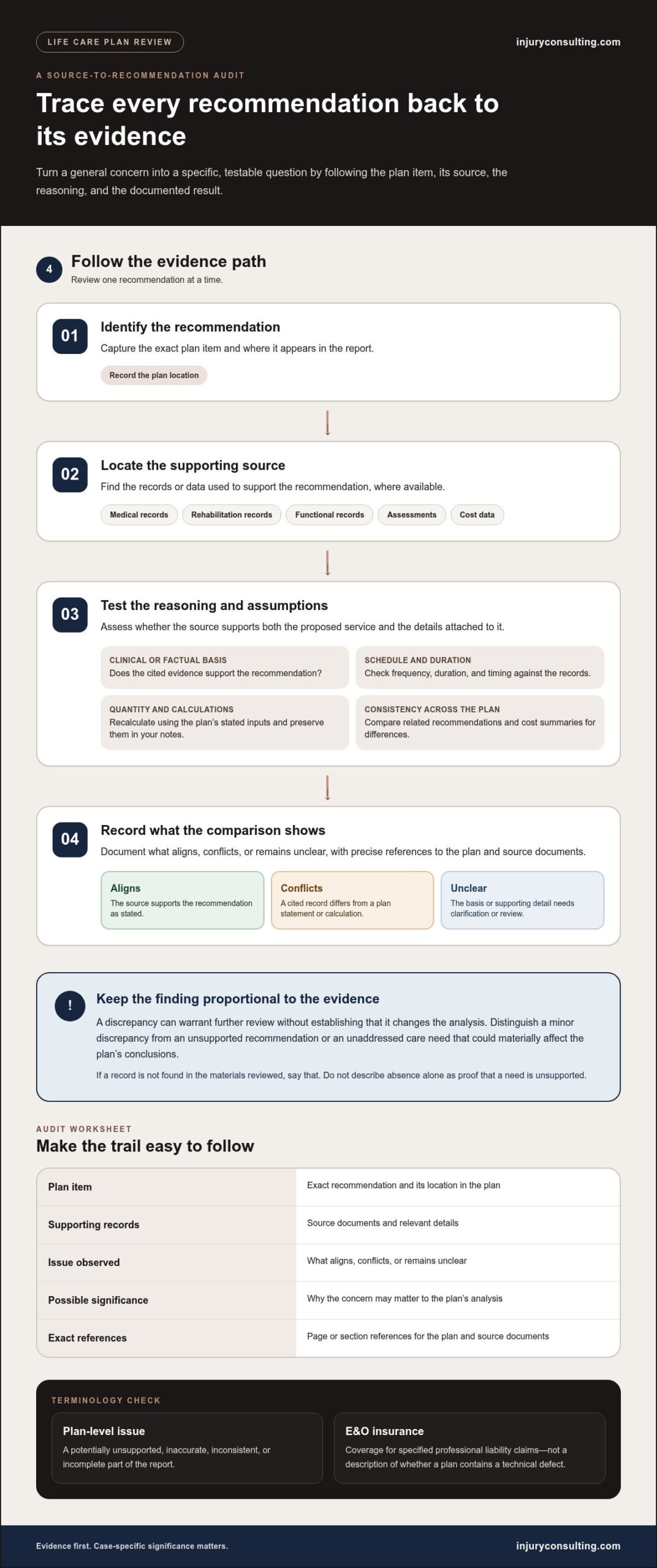
A useful audit log shows what was examined, where the evidence came from, and why an issue may matter. Keep each entry concise and reproducible. Separate established facts from disputed interpretations and information that remains unavailable. This helps prevent an unresolved question from being presented as a proven defect.
For each potential issue, record:
Use exact page numbers, section headings, and record references instead of general descriptions such as “medical records” or “cost data.” If a source isn’t available in the materials reviewed, say so without inferring what it contains. A clear citation trail lets another reviewer locate the same passage and assess the reasoning independently.
Assign each concern a unique entry number and preserve references to both the plan and its source. State the discrepancy first, then explain its possible relevance. For example, distinguish “the plan lists a frequency that differs from the cited schedule” from “the recommendation is unreasonable.” The first is a checkable observation; the second needs supporting analysis. Update each entry as the concern is clarified or remains unresolved.
Use status terms consistently. “Resolved” means the concern has been addressed by the materials reviewed. “Disputed” identifies an ongoing disagreement. “Further analysis needed” signals that the available record doesn’t yet support a conclusion. Consistent labels help prevent a preliminary question from being mistaken for a final finding and keep the audit useful as the case record develops.
Prioritize issues with a clear record basis and a meaningful potential effect. Explain the evidence, the reasoning, and the conclusion in plain language. Avoid broad assertions about the planner’s competence or motives. A focused critique addresses what the plan says, what the cited support shows, and how the difference may affect the analysis.
When the audit identifies disputed assumptions or conclusions that need case-specific clinical analysis, a life care plan rebuttal review can examine the opposing plan’s support and reasoning. Injury Consulting LLC’s rebuttal work draws on peer-reviewed data and 30 years of clinical experience, with reports designed to be defensible in court and withstand cross-examination.
An initial audit can identify where a recommendation, assumption, or calculation needs closer review. A rebuttal expert may be useful when the remaining question requires more than locating a discrepancy. The task is to evaluate how the opposing plan connects the case evidence to its conclusions and explain the basis for any disagreement in a clinically grounded, case-specific way.
A rebuttal isn’t simply a list of objections. It examines the other plan’s support, assumptions, and reasoning in light of the available case materials. That analysis can help clarify whether a disputed item reflects a documentation gap, a difference in interpretation, or a conclusion that may affect the plan’s projected needs.
Consider a focused review when recommendations rely on assumptions that are difficult to trace to the record, or when material calculations, timelines, or projected needs remain disputed after an initial audit. A rebuttal expert can also explain the clinical basis for a disagreement with the opposing plan’s reasoning. The purpose is to examine specific contested issues, not to presume the plan is wrong.
Before the review, organize the audit findings. Identify the disputed recommendations, relevant source documents, unresolved questions, and possible effects on the plan’s conclusions. This defines the scope and helps distinguish issues that need expert analysis from matters that can be resolved by checking a citation or calculation.
A case-specific review should connect each opinion to its evidentiary basis. Dr. Raphael Sadiwa’s work draws on peer-reviewed data and 30 years of clinical experience. The analysis should explain what the records support, where the opposing plan makes an inference or projection, and why a disputed assumption may or may not be justified by the available information. The aim is clear reasoning, not rhetoric.
Documentation matters. A well-supported rebuttal identifies the plan passages and records at issue, explains the analytical disagreement, and states its potential significance without overstating what the evidence shows. Reports are designed to be defensible in court and withstand cross-examination. No review can guarantee a particular case outcome, but precise reasoning makes the basis of an opinion easier to assess.
Attorneys reviewing potential life care plan errors and omissions can use a rebuttal review to move from an issue log to focused analysis of disputed findings. Injury Consulting provides life care plan rebuttal services nationwide for attorneys handling injury and disability cases. To discuss a case, request life care plan rebuttal assistance.
A technical review is most useful when it leads to a precise decision: which disputed points warrant further analysis, what evidence could resolve them, and how each issue relates to the case. Keep that focus as the record develops. Update open questions when new materials arrive, and preserve the distinction between confirmed facts and unresolved concerns.
That discipline helps attorneys address life care plan errors and omissions without overstating what the evidence shows. If a disputed plan needs case-specific analysis beyond the initial audit, a focused rebuttal review can examine its reasoning and support.
Dr. Raphael Sadiwa’s life care plan rebuttal work draws on peer-reviewed data and 30 years of clinical experience. Injury Consulting serves attorneys handling injury and disability cases nationwide. Discuss a case-specific life care plan rebuttal and take the next step toward clear, evidence-linked analysis.
No. In a plan review, “errors and omissions” refers to possible problems in the report, such as an unsupported recommendation or an unaddressed need. E&O insurance is a policy that may cover specified professional liability claims. The terms address different questions: one concerns what the plan says, while the other concerns insurance coverage. Policy language and applicable law govern coverage questions.
Potential errors include a statement that conflicts with a cited record, a proposed service schedule without a clear basis, duplicated services, or a total that doesn’t match the plan’s stated inputs. For example, a reviewer might find that the narrative describes one duration while a summary table uses another. Treat each as a point to verify against the full record, not as proof of fault on its own.
A material omission is a potentially relevant need or piece of support left out of the plan that could affect its analysis. Ask what conclusion might change if the omitted item were included. For instance, a record describing a functional limitation may warrant examination if the plan’s recommendations don’t account for it. Whether that gap matters depends on the evidence, the plan’s scope, and the case facts.
Create a dated entry identifying the exact plan passage and the source material you compared it with. Quote or accurately describe the conflicting information, then explain its possible significance without reaching beyond the evidence. Include document titles, dates, page references, and calculation inputs needed to repeat your check. Mark unresolved questions clearly, and retain the reviewed version of the plan so later changes don’t blur the audit trail.
No. A discrepancy may be clerical, isolated, or unrelated to a central recommendation. Consider whether correcting it would change a projected need, service schedule, or other conclusion. A typo that leaves the analysis unchanged differs from a repeated inconsistency that affects several recommendations. Evaluate the issue in context and describe its demonstrated or potential effect rather than making a sweeping judgment about the entire plan.
Yes. A rebuttal can examine disputed statements, missing support, assumptions, or projections and explain how they relate to the case evidence. It may also distinguish a clear factual discrepancy from a disagreement about interpretation or future need. The analysis should identify its evidentiary basis and explain the limits of what can be concluded. A rebuttal addresses the plan’s reasoning; it doesn’t by itself determine fault or coverage.
An audit is a process for checking a plan’s statements, supporting records, assumptions, and calculations. It can identify questions for follow-up without taking a position on every issue. A rebuttal is a case-specific expert response that analyzes disputed parts of another plan and explains a supported disagreement. An audit may help define the issues; a rebuttal develops the clinical analysis needed to address selected findings.
Contact Dr. Raphael CV DownloadDr. Raphael reviews your case, documents every future cost your client will face. Explained in a way that juries understands. Dr. Raphael delivers a report built to survive cross-examination. Available nationwide. Call, text, or email to discuss your case.