Published on October 21, 2026
Contact Dr. Raphael CV DownloadThe life care plan cost for traumatic brain injury is an individualized projection, not a fixed figure. A plan estimates the survivor’s future needs and related expenses, including care, rehabilitation, equipment, daily assistance, and housing adaptations. The total depends on the person’s impairments, required services, and living arrangements.
The contents of the plan matter as much as its final estimate. A useful projection links documented needs to the frequency of care, who will provide it, and the equipment or home changes required. This article explains what a TBI life care plan can include, how housing and support needs affect projected costs, and why estimates vary. It also describes how a thorough plan accounts for changing needs over time.
A life care planner builds a TBI projection from the survivor’s documented history and current function. The review should include hospital and physician records, imaging results, therapy notes, medication history, and neuropsychological assessment findings. Each source answers a different question. Imaging and acute-care records describe the injury; therapy notes show progress and limitations; neuropsychological findings help identify cognitive changes that affect daily tasks, supervision, and replacement services.
Interviews add details that records may not capture. The planner speaks with the survivor and family about routines, communication, memory, mobility, safety, and the help needed at home. A family member might clarify whether the survivor needs medication reminders, help preparing meals, or supervision in unfamiliar settings. The planner compares these examples with clinical findings, linking a reported limitation to a specific service rather than relying on a broad label such as “ongoing care.”
The resulting care plan projects medical, rehabilitation, and social service needs. It identifies the service required, its expected frequency, who may provide it, and how the survivor will travel to appointments. For example, rehabilitation after TBI may take place several times a week. A projection should distinguish therapy from physician follow-up, medication management, behavioral support, and help with community activities. Because needs can change with function, the plan links each recommendation to the record and the survivor’s current abilities.
How can someone find and compare TBI life care planners? Compare relevant training, experience with brain injury records, assessment methods, and the ability to explain each recommendation using supporting evidence. Review whether reports clearly connect functional findings, service frequency, provider type, and projected needs.
For a practical comparison, examine how each planner handles conflicting evidence. One report may recommend frequent supervision based on family interviews; another may rely on cognitive testing and observed function. The key question is whether the reasoning addresses both sources and explains any difference. Also look for stated assumptions, a clear distinction between current care and future projections, and an explanation of how rehabilitation or support services relate to specific limitations. This structure makes the plan easier to evaluate in a legal proceeding.
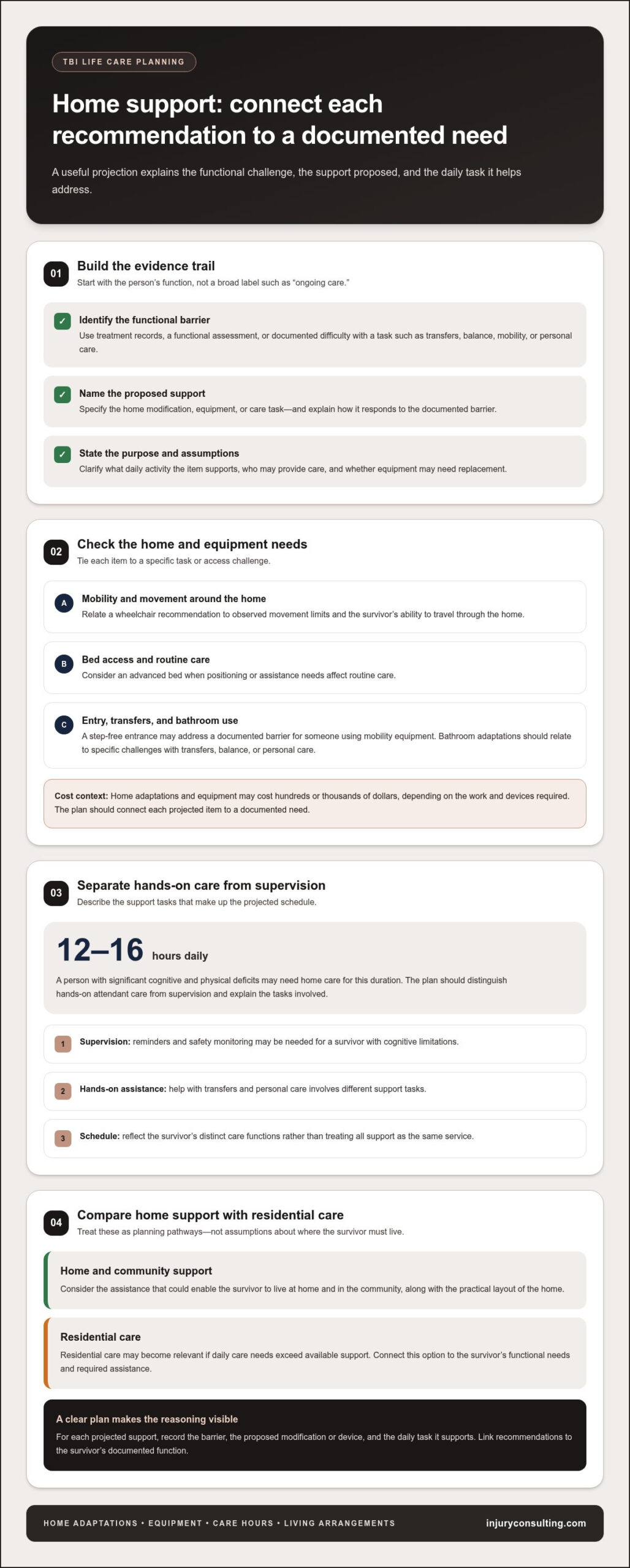
Home support affects a TBI survivor’s projected needs when daily activities cannot be managed safely without assistance. A planner links each adaptation to a functional challenge. For example, difficulty transferring from a wheelchair may support a recommendation for an accessible bathroom or entry. Home adaptations and equipment may cost hundreds or thousands of dollars, depending on the work and devices required. Each projected item should relate to a documented need.
Equipment recommendations should explain the function of each item and whether it may need replacement. Wheelchairs and advanced beds are examples of durable medical equipment used after brain injury. The plan can describe whether a device supports mobility, positioning, or safe care at home. A treatment record, functional assessment, or documented transfer difficulty can link the recommendation to the survivor’s needs.
Care hours can shape long-term projections. A person with significant cognitive and physical deficits may need home care for 12 to 16 hours daily. The plan should distinguish hands-on attendant care from supervision. For example, a survivor who needs reminders and safety monitoring requires different support tasks from someone who needs help with transfers and personal care. The schedule should reflect those distinct functions.
Home care and residential placement are separate planning pathways. A life care plan should consider support that enables a survivor to live at home and in the community, rather than assume permanent facility residence. The comparison should account for functional needs, required assistance, and the home’s practical layout. If daily care needs exceed available support, residential care may become relevant. Each option needs a documented connection to the person’s needs.
Clear documentation strengthens the estimate. Record the barrier, proposed modification or device, and daily task it supports. A Functional Capacity Evaluation can help assess how physical abilities affect activities such as lifting, transfers, and mobility. That evidence can clarify which home supports relate to function and which assumptions require further analysis.
A TBI projection combines separate future needs into an itemized estimate. Its total reflects the services, duration, local rates, and assumptions supported by the record.
Categories group projected expenses by purpose, such as medical treatment, rehabilitation, psychological support, attendant care, equipment, and transportation. This breakdown shows what drives the total instead of presenting one unexplained figure. A hospital stay, recurring therapy, and replacement equipment each follow different cost patterns. A life care planner links every category to a documented need and explains its frequency.
What factors affect the cost of a TBI life care plan? The survivor’s functional limitations, required services, care frequency, location, life expectancy, and future price changes all shape the projection.
Local projections use service rates and availability in the survivor’s community. This matters because caregiver wages and medical costs vary by location; national averages may not reflect the services actually accessible near the home. A California planner, for example, may project severe TBI care over 40 years. Attorneys can compare the assumptions with local care needs and the survivor’s assessment.
How much does a traumatic brain injury life care plan cost in the United States? There is no single national total for projected care.
How long does it take to complete a TBI life care plan? Timing depends on the volume of records, access to assessments, interviews, and the complexity of projected needs. Medical records, therapy notes, and family interviews all inform the final analysis.
Inflation adjusts today’s service estimates to account for costs projected years ahead. Medical care projected 20 or 30 years into the future may cost significantly more than it does now because medical cost inflation has historically outpaced general inflation. A sound projection accounts for rising prices, replacement devices, and substitute caregivers. These assumptions matter most when services recur over a long period.
Caregiver projections distinguish paid assistance from support provided by family members. They also identify the tasks, schedule, and provider type involved. Lost income is a separate damages issue, not a future-care cost. For example, a lawyer may assess employment evidence separately while the life care planner documents attendant care needs and projected service costs.
Does health insurance or Medicare cover the cost of a life care plan? Don’t assume coverage for preparing the plan: it is an expert projection, separate from the treatment and equipment it may describe. Coverage for projected medical services is a distinct question.
The price depends on the case’s scope, records, and projection complexity; a quote is provided for the specific case.
Adaptive housing translates a survivor’s functional needs into changes that support daily life at home and in the community. The plan should link each modification to a specific barrier. For example, a wheelchair user may need an accessible route between the entrance, bedroom, and bathroom. The aim is not to assume institutional placement, but to assess what support makes community living workable.
Assistive technology and equipment should be tied to specific tasks, not listed as a generic allowance. A wheelchair addresses mobility needs; an advanced bed may support positioning and caregiving. The plan should explain how each item relates to documented function, who will use it, and whether replacement is expected. Home adaptations and equipment may cost hundreds or thousands of dollars, depending on the item and work involved.
Current function is only part of the projection. A life care plan should consider how needs and services may change as the survivor ages. A layout that works with current mobility may become inadequate if movement, balance, or caregiving needs change. The planner can distinguish adaptations needed now from future equipment or housing needs, then explain the records and functional findings behind each projection.
Technology also has a practical life cycle. A device may need replacement as it wears out, no longer meets the survivor’s needs, or becomes unsuitable after a functional change. Projected costs should account for replacement devices and substitute caregivers where relevant. The plan should avoid double-counting, such as listing both a device and a broader equipment allowance that covers the same function.
Housing analysis should compare the survivor’s current home with the support required there. If an adaptation cannot address a documented access or care barrier, the plan can assess other living arrangements and explain why. This comparison makes assumptions visible: which features support independent activity, which require assistance, and how equipment, transportation, and care fit together. Each recommendation should connect to records, a defined task, and the survivor’s expected function.
A TBI life care plan is an itemized, dynamic document that assesses current and future needs and estimates related costs. Its value lies in linking each recommendation to a functional limitation, treatment need, or support requirement. For example, difficulty communicating may support projected speech therapy, while cognitive changes may call for behavioral support or help with daily routines. The plan should also explain how needs may change as the survivor ages.
Typical categories include physical health, mental health, pharmaceuticals, diagnostic testing, rehabilitation, equipment, transportation, and home care. Medical services may include routine primary care, occupational therapy, and speech therapy. A projection can also address family counseling, ancillary costs of home support, and potential complications that could increase care needs. Therapy frequency should reflect the person’s needs; twice-weekly sessions can illustrate how recurring services are itemized.
Family input can clarify how TBI affects daily function outside appointments. A family member may describe missed medication, difficulty completing household tasks, or changes in communication. The planner can compare these examples with medical records and assessment findings, then identify replacement services or supervision needs. Personal injury claims may involve disputed future damages, so each projected service needs a clear rationale rather than appearing as a general allowance.
Who is qualified to prepare a traumatic brain injury life care plan? A certified life-care planner may be a physician, nurse or rehabilitation professional with specialized training. Applicants for the Certified Life Care Planner certificate must complete 120 hours of post-graduate or post-specialty degree training in life-care planning.
A defensible plan states the service, its purpose, expected frequency, and the evidence supporting it. For instance, an occupational therapy recommendation should link to a documented functional need, not simply the TBI diagnosis. The plan should also account for what may happen if recommended services aren’t received. This analysis helps distinguish a necessary projection from an unsupported assumption.
Plans can be updated when the survivor’s condition or available treatments change. A new assessment, a change in mobility, or different medication needs may alter projected services. Reviewers should examine whether an update explains what changed and how that affects future care. This keeps the document useful beyond a single snapshot of function.
For a case-specific projection grounded in documented needs, explore life care planning.
Injury Consulting LLC develops life care plans that link a survivor’s documented limitations to projected future needs. Turn to this analysis when a TBI case requires an evidence-based estimate of care, rehabilitation, equipment, or housing support. Dr. Raphael Sadiwa’s work draws on peer-reviewed data and clinical experience, with reports designed for courtroom scrutiny and cross-examination.
When an existing plan’s assumptions or recommendations need examination, Life Care Planning Rebuttal can address the disputed analysis. Physical Therapy Expert Witness services and Functional Capacity Evaluation (FCE) can also inform questions about physical function and activity limits. These services support evidence evaluation; they don’t replace medical diagnosis, treatment, or legal representation.
Contact Injury Consulting LLC to discuss life care planning for a TBI matter.
The life care plan cost for traumatic brain injury is meaningful only when its assumptions can be traced to the survivor’s documented needs. The next step is to identify what the legal team needs to evaluate: a new projection, a challenge to an existing plan, or expert analysis of physical function. That focus keeps the review tied to the case issues and the evidence under consideration.
Injury Consulting LLC offers Life Care Planning, Life Care Planning Rebuttal, and Physical Therapy Expert Witness services. Its reports draw on peer-reviewed data and clinical experience, with analysis designed for courtroom scrutiny. Choose the service that fits the legal team’s question, whether that means developing a plan or evaluating another expert’s conclusions.
For a focused discussion of the needs and evidence in your matter, contact Injury Consulting LLC. A clear next step can help your team move forward with a more organized, supportable analysis.
A brain injury life care plan is a structured projection of future services and support, matched to a survivor’s documented needs. It turns clinical findings into practical planning categories. For example, a report may link difficulty communicating with ongoing speech therapy, or cognitive limitations with supervision during daily activities. Recommendations should have a clear rationale so readers can understand how the evidence supports each projected need.
Key expenses may include hospital care, physician visits, medication, rehabilitation, diagnostic testing, and mental health services. A hospital stay can cost thousands of dollars per day, while ongoing needs may involve recurring therapy or follow-up care. The mix depends on the injury’s effects. For example, a survivor with communication difficulties may need speech therapy, while another may require continued medication management or psychological support.
A life care plan gives a TBI survivor’s legal and care teams a structured way to evaluate future needs. It can show how cognitive, physical, or behavioral limitations affect specific activities, such as managing medication or returning to community routines. For attorneys, this organization can clarify which projected services relate to documented impairments. It also provides a framework for examining assumptions and identifying where records support or challenge a recommendation.
There is no single amount that applies to every survivor. The life care plan cost for traumatic brain injury depends on the person’s impairments, expected services, location, and life expectancy. A useful estimate separates recurring care from one-time needs and accounts for changes over time, while distinguishing future-care projections from other claimed damages, such as lost income.
A life care plan can help attorneys evaluate the long-term economic consequences claimed in a TBI case. Its itemized projections give both sides a basis for reviewing the services, frequency, and assumptions behind future-care damages. For example, a dispute may focus on whether a recommended service is reasonably necessary or how often it will be needed. The report informs negotiation; it does not determine the settlement amount or outcome.
It is a case-specific document that projects future care and support related to a TBI survivor’s functional needs. Unlike a treatment record, it looks ahead and organizes anticipated services for evaluation. A plan may address how needs could evolve if mobility, cognition, or behavior changes. Its purpose is to make the basis for projected care understandable, including the findings behind each recommendation and the assumptions that affect the estimate.
Depending on the survivor’s needs, a plan may include primary care, mental health care, occupational and speech therapy, medications, diagnostic testing, attendant care, equipment, transportation, and home support. Family counseling may also be considered when relatives need help preparing for changes after the injury. Recommendations should match documented needs. For instance, transportation can be relevant when a survivor cannot independently reach recurring appointments.
To estimate the life care plan cost for traumatic brain injury, planners identify each service, its expected frequency and duration, and the relevant local price. The analysis also considers life expectancy, inflation, replacement equipment, and possible changes in care needs. A recurring service and a one-time home adaptation require different calculations. Reviewers can test the estimate by tracing each projected item to its supporting records and examining the assumptions used.
Contact Dr. Raphael CV DownloadDr. Raphael reviews your case, documents every future cost your client will face. Explained in a way that juries understands. Dr. Raphael delivers a report built to survive cross-examination. Available nationwide. Call, text, or email to discuss your case.